Risk of Non-Transparent Activities and Uncontrolled Discharges in the Vilija Basin (Belarus)
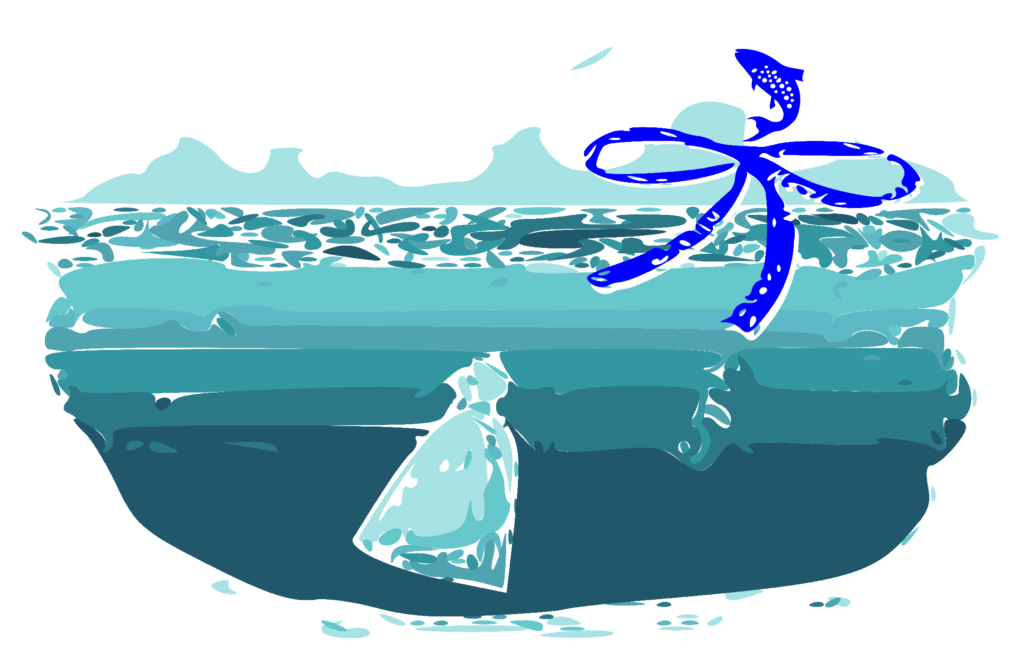
Limited transparency in Belarus increases risks of undetected pollution affecting downstream Lithuanian waters
Country: Belarus and its political context → implications for Lithuania
Problem formulation
On the territory of Belarus, the Vilija River and its associated water bodies are used for various types of economic activity, including industrial water use, agriculture (notably pig farming), and infrastructure-related processes that may generate pollution pressures on the water system.
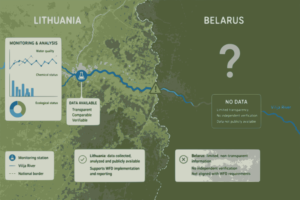
In contrast to Lithuania, where pollution incidents in the Neris River may become the subject of public attention, investigation, and open discussion, comparable information in Belarus is largely absent from the public domain. This difference does not indicate the absence of environmental problems upstream but reflects fundamentally different levels of transparency and access to information. In the Belarusian context, potential pollution events – including unauthorised discharges or other impacts on the water system – may remain outside public scrutiny, independent verification and international oversight.
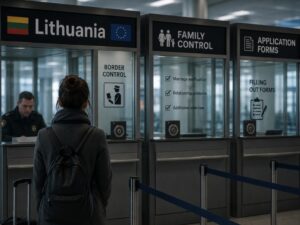
Limited access to environmental information, the reduction of public oversight since 2020, and Belarus’s withdrawal from the Aarhus Convention in 2022 further increase the risk that potentially significant impacts on the water system may occur without timely detection and external verification.
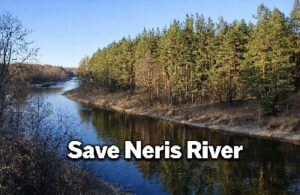
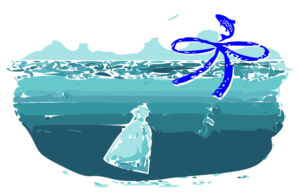
An additional risk is illustrated by the fact that even in a context with more developed environmental control systems and active civil society (such as Lithuania), identifying pollution sources can be challenging. For example, in one case involving plastic pollution in the Neris River, the source of the discharge could not be conclusively identified despite investigations and public attention. This highlights the inherent complexity of tracing pollution sources even under comparatively transparent conditions.
Furthermore, riverbed clean-up activities in Vilnius revealed a significant accumulation of anthropogenic waste (over 2 tonnes within a limited section), including materials capable of releasing pollutants over time. This indicates that certain pressures on the water system may remain undetected and only become visible retrospectively.
In the Belarusian context, where independent oversight is limited, such risks carry a higher degree of uncertainty, and the nature, sources, and scale of anthropogenic pressures on the Vilija River remain only partially transparent.
Risk for Lithuania and WFD implementation
This creates a direct risk for Lithuania as a downstream country, as pollutants originating from economic activities upstream may enter the Neris River without timely detection or response.
In the absence of transparent and independently verifiable control over pollution sources upstream, Lithuania cannot fully account for all anthropogenic pressures affecting the water system. This reduces the effectiveness of water quality management and complicates the achievement of good ecological and chemical status under the WFD.
Why this is a systemic problem
The problem is systemic in nature and driven by the following factors:
the presence of potentially polluting economic activities within the basin
the absence of independent control and verification mechanisms
the inability to ensure timely detection of unauthorised discharges and diffuse pollution
limited access to environmental information and reduced public oversight
the inherent difficulty of identifying pollution sources even under more advanced monitoring systems
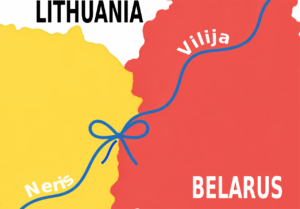
Thus, the issue is not only a lack of transparency but also a structural vulnerability, whereby potential sources of pollution may remain outside independent control and timely detection, creating a persistent transboundary risk for the Neris–Vilija water system.
About The Author