Belarus: Absence of Independent, Objective, and Verifiable Monitoring on the Vilija
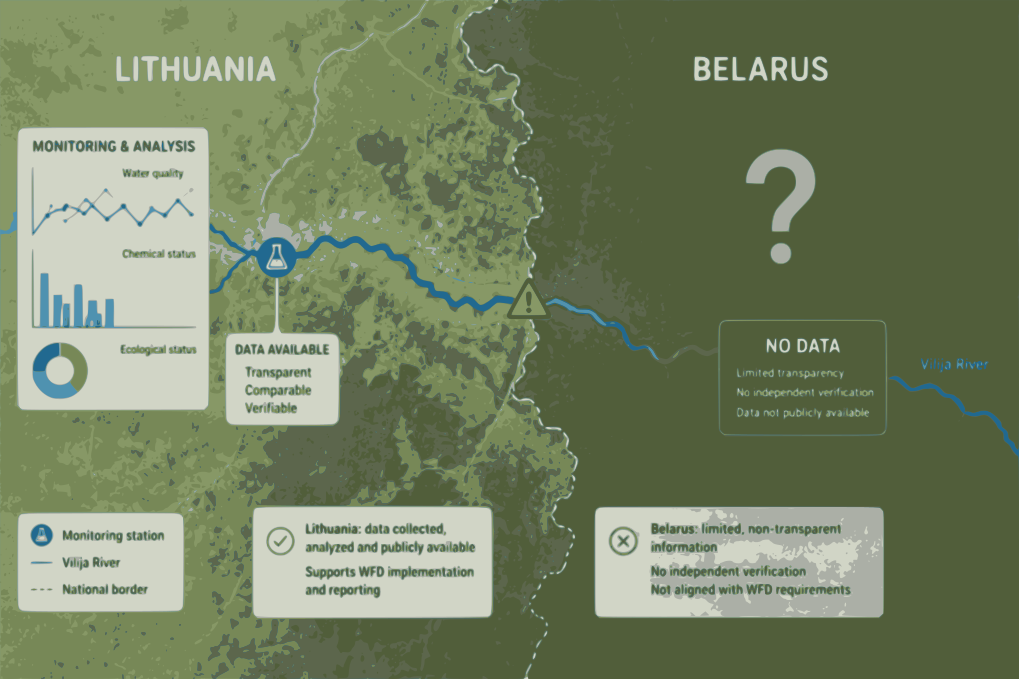
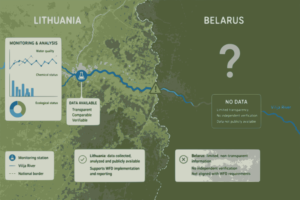
Limited transparency in Belarus’s water monitoring creates systemic risks for Lithuania’s downstream WFD compliance.
Country context: Belarus and its political climate, and its implications for Lithuania
Problem formulation
In Belarus, water resource monitoring, including hydrological monitoring of rivers in the Nemunas basin (including the Vilija River), is carried out within a centralized state environmental monitoring system. Data collection and analysis are conducted by state authorities and affiliated scientific institutions, without institutionalised mechanisms for independent verification of environmental information.
At the same time, publicly available information on the condition of water resources and the management of transboundary basins is limited and fragmented. Available materials are largely general or descriptive, while regular, detailed, and comparable reporting on water quality and the ecological status of transboundary water bodies is either absent from the public domain or significantly restricted.
Additionally, international assessments indicate the need for further development and modernisation of Belarus’s water monitoring system, including improvements in data quality, comparability, and alignment with the approaches of the EU Water Framework Directive (WFD). It is also noted that the country’s water resource and environmental data management system remains under development and requires further improvement in terms of transparency, accessibility of information, and integration into international water governance practices.
Limitations in transparency are further reinforced by institutional and political factors. Since 2020, opportunities for public oversight and civil society participation in the environmental sector in Belarus have significantly declined. Furthermore, Belarus’s withdrawal from the Aarhus Convention in 2022 – which establishes international standards for access to environmental information and public participation – has further restricted possibilities for independent verification of environmental data.
Taken together, this creates a situation in which data on water conditions in the upstream part of the transboundary basin (the Vilija River) lack sufficient transparency, detail, and independent verifiability.
Risk for Lithuania and WFD implementation
This creates a structural constraint on the implementation of the EU Water Framework Directive in Lithuania. As a downstream state, Lithuania is required to assess the ecological and chemical status of water bodies at the level of the entire river basin. However, the absence of comparable, transparent, and independently verifiable upstream data reduces the reliability of such assessments and limits the ability to fully confirm the achievement of good ecological and chemical status.
Why this is a systemic problem
The problem is systemic in nature and is driven by the following factors:
the centralized and state-controlled nature of monitoring, including risks of data manipulation by Belarusian state structures
the absence of independent mechanisms for verification of environmental data in Belarus
limited public availability of detailed information
insufficient comparability of data with WFD approaches and requirements
Thus, this is not a case of isolated data gaps but rather structural characteristics of the monitoring system that create a persistent transboundary risk for water resource management in the Vilija–Neris basin.
About The Author