How EU public funds risk enabling environmental degradation and militarisation in the Neris river basin
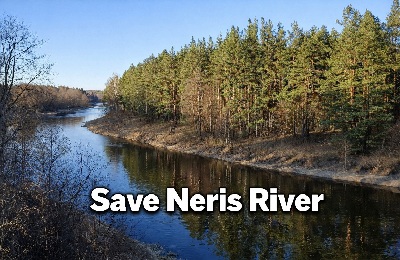
The Neris River – known upstream in Belarus as the Viliya – is a transboundary ecosystem of high ecological value. It is also a case where EU public funding frameworks are being positioned in ways that risk enabling outcomes that directly contradict the environmental objectives they are meant to support.
Flowing from Belarus through Vilnius and into the Nemunas and the Baltic Sea, the river connects protected habitats, nuclear infrastructure, and emerging military logistics corridors within a single system. This overlap reveals not a temporary policy tension, but a structural misalignment in how EU public money is prioritised, governed, and potentially deployed.
Public money and dual-use infrastructure
In recent years, Lithuania has expanded planning for infrastructure linked to military mobility. National decisions and EU instruments – including the Connecting Europe Facility – are designed to support upgrades of transport corridors, including infrastructure crossing the Neris, often framed as dual-use.
It remains unclear to what extent EU funds have already been allocated to specific Neris-related projects. However, these projects are clearly being positioned within the scope of EU financial support. This creates a structural risk: European taxpayers’ money may be directed toward infrastructure that operates in tension with legally protected environmental zones.
This reflects a broader shift in EU priorities toward security and rapid deployment capacity. Yet when such funding frameworks are applied to Natura 2000 areas, they generate a high-risk overlap between environmental protection obligations and strategic infrastructure planning.
Structural contradiction: conservation versus militarisation
The Neris valley is part of the Natura 2000 network and is legally designated as a priority biodiversity area under EU law. This status imposes strict limitations on interventions that alter river morphology or ecological integrity.
At the same time, planning discussions in Lithuania have included:
- dredging and straightening sections of the river
- removal of natural rapids to enable navigation
- integration of the river into evacuation and logistics systems
Such measures are incompatible with Natura 2000 obligations. They alter hydrology, disrupt habitats, and undermine conservation objectives.
This is not a marginal policy inconsistency. It reflects a structural contradiction: a river legally protected as a biodiversity priority is simultaneously being reframed as strategic infrastructure.
Environmental funds and financial integrity risks
A more serious concern lies in how environmental funding is understood and potentially used.
Discussions around river modification have included references to funding sources associated with environmental protection, including Natura 2000-linked instruments . This raises a fundamental question of financial governance:
Why are Lithuanian policymakers even considering the use of Natura 2000-linked funding for interventions that would degrade a legally protected river system?
This raises concerns not only about policy choices, but about whether decision-makers fully understand the legal purpose and limitations of Natura 2000 funding instruments.
This is not a technical misunderstanding. Natura 2000 funding is not neutral infrastructure financing. It is legally tied to conservation outcomes. Using – or even proposing to use – such funding for activities that damage protected habitats signals either a profound misinterpretation of EU rules or a willingness to stretch them beyond their intended purpose.
The risk is systemic:
- environmental funding may be repurposed or indirectly linked to harmful interventions
- infrastructure planning proceeds within protected areas without clear financial boundaries
This undermines not only environmental protection but the integrity of EU funding architecture itself.
Accountability gaps in EU financial governance
These developments expose gaps in accountability at both national and EU levels.
Lack of transparency
Projects linked to military mobility or civil protection are often framed in security terms, limiting public scrutiny over funding sources and project design.
Reclassification dynamics
Projects can shift from civilian to dual-use categories, expanding access to funding while weakening environmental safeguards.
Weak enforcement of conditionality
There is no clear evidence that Natura 2000 obligations are being consistently enforced in the context of infrastructure planning linked to EU-supported frameworks.
This raises direct concerns about the effectiveness of European Commission oversight and the enforcement of environmental conditionality in EU-funded or EU-aligned projects.
Transboundary risk and cumulative impact
The financial governance issue becomes more acute at the basin level.
Upstream, the Belarusian nuclear power plant depends on the Viliya River for cooling and discharge, with a documented history of incidents and unresolved safety concerns. Plans for a radioactive waste facility within the same basin further increase long-term risks .
Downstream, infrastructure planning linked to EU funding frameworks is redefining the river as a strategic corridor.
These dynamics interact cumulatively:
- ecological degradation increases system vulnerability
- militarisation increases the likelihood of the river becoming a strategic target
- any contamination event would propagate downstream into the Nemunas and the Baltic Sea
The Baltic Sea, already heavily burdened environmentally, would absorb these combined risks.
Conclusion: a systemic risk of misallocation
The Neris river basin does not yet represent a confirmed case of misuse of EU funds. It represents something more structurally significant: a policy and financial environment in which such misuse becomes highly likely.
EU public funding frameworks are currently positioned in ways that:
- allow overlap between environmental protection and infrastructure objectives
- create incentives for reinterpreting protected areas as strategic assets
- weaken the practical enforceability of Natura 2000 obligations
This creates a clear risk of future misallocation of public funds.
Addressing this requires:
- strict separation of environmental and infrastructure funding streams
- explicit prohibition of using conservation-linked funds for river modification in protected areas
- full transparency on all projects affecting Natura 2000 sites
- strengthened oversight by the European Commission
- clear enforcement of environmental conditionality across all EU funding instruments
Without these measures, EU public money risks being channelled into activities that directly contradict its own legal and policy foundations.


About The Author