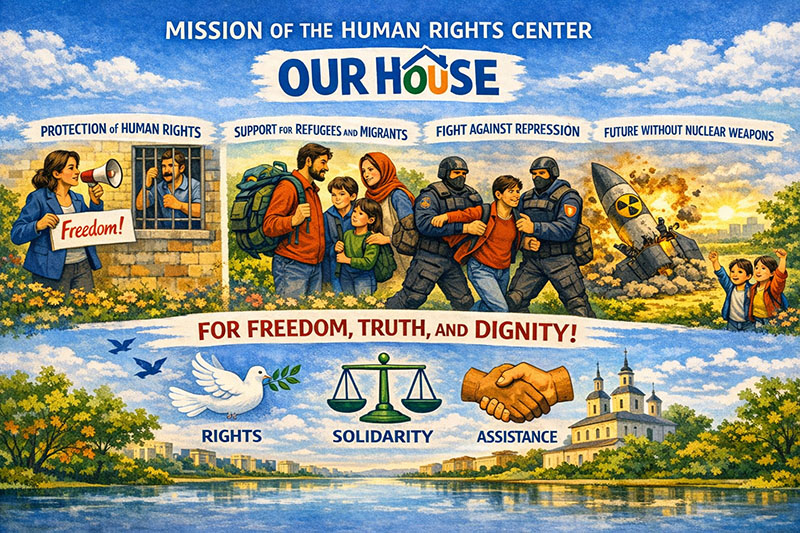
Our House sees its activities as a long-term process of social development and public learning. We seek to create a space for searching for and testing ideas of nonviolent change, discussing complex moral issues, and building a culture of solidarity.
Our work shows that social values can change, even if this process takes years and is accompanied by serious trials. The foundation of our model for the future of Belarus – and in the broader regional context – is nonviolence, respect for human dignity, and the capacity for public dialogue.
Initially, the mission of Our House was connected with finding ways for the nonviolent transformation of Belarus from a dictatorial regime into a democratic society. We saw ourselves as a platform for civic experimentation. It was a laboratory of ideas and practices aimed at gradual, sustainable, and nonviolent change. We created an extensive decentralized network of city groups united not by a vertical management structure, but by horizontal connections.
Over time, the situation in the region changed. The strengthening of authoritarian regimes, large-scale repression in Belarus, and the war in the region have raised a broader question for society – the question of the very architecture of security.
In these circumstances, the mission of Our House has evolved. Today it is connected not only with the democratic transformation of Belarus, but also with the search for and implementation of a new security model for the entire region, one centered on human rights, human dignity, and nonviolent methods of resolving conflicts.
We are convinced that security is impossible in conditions of war. It is also impossible under dictatorial and authoritarian regimes that systematically violate human rights. A society cannot be truly secure if the state suppresses freedom, punishes dissent, and uses violence as its primary instrument of governance.
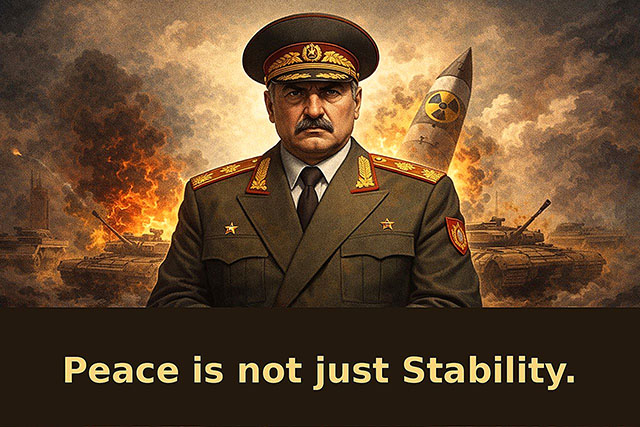
Therefore, we do not accept the simplified formula that «is peace merely the absence of war». Authoritarian propaganda actively uses this idea to present «stability» as the highest value.
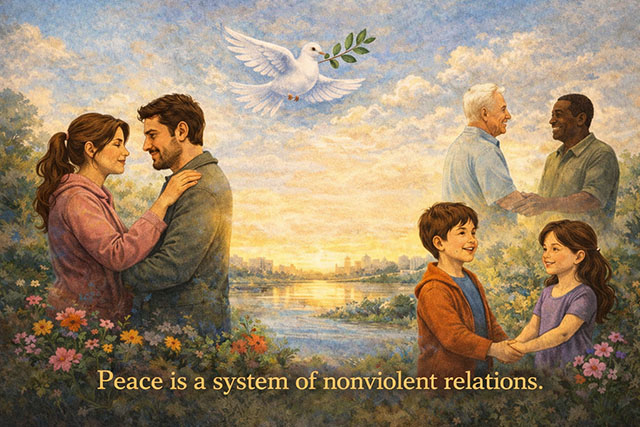
For us, genuine peace is a system of nonviolent relationships on three interconnected levels.
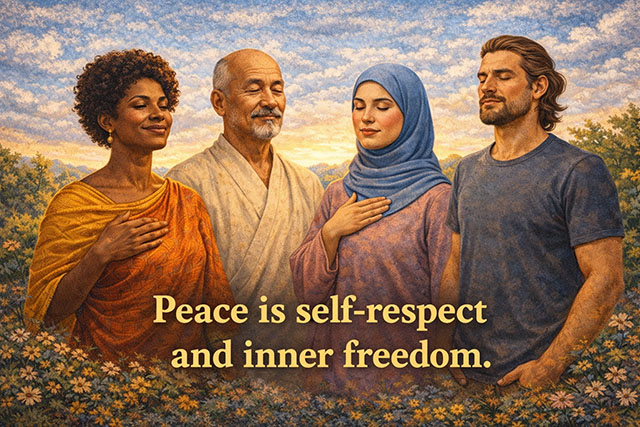
The first level is nonviolence toward oneself. For people who grew up in authoritarian societies, this is a particularly difficult task. Authoritarian culture cultivates habits of fear, self-devaluation, and constant internal pressure. People become accustomed to treating themselves poorly, failing to respect their own boundaries and dignity. Therefore, the formation of a culture of self-respect and inner freedom becomes an important part of broader social transformation.
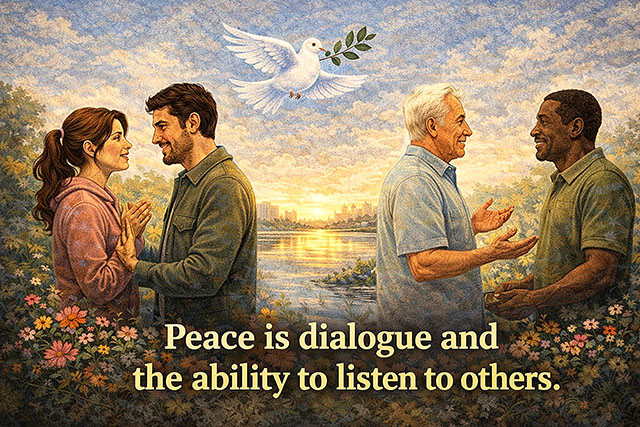
The second level is nonviolence in relationships between people and within communities: in families, organizations, and civic initiatives. This means the ability to resolve conflicts without humiliation, pressure, or psychological violence. This concerns not only physical violence but also much more subtle forms – manipulation, intimidation, and the suppression of other viewpoints. A culture of dialogue, the ability to hear others, and the capacity to find compromises are key elements of a sustainable society.
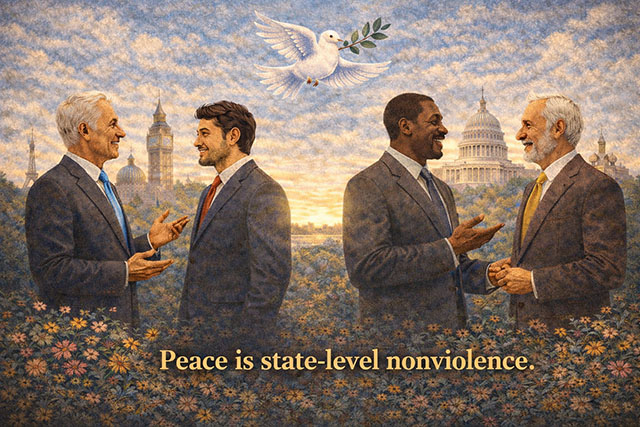
The third level is nonviolence at the level of states and relations between countries. It also includes nonviolence by the state toward its own citizens.
For Belarus, this level is particularly complex. The modern state system largely functions as a punitive machine. If one carefully examines Belarusian legislation and state practices, it becomes clear that they are largely built on the principle of punishment rather than support. This manifests itself in many areas – from social policy to criminal law.
A person who finds themselves in a difficult situation, regardless of whether they are guilty or not, usually encounters not assistance but additional pressure. State institutions tend to punish rather than solve the problem. This approach extends to many different groups of people – children, women, people with disabilities, and the elderly – as well as to issues that at first glance may seem unrelated to politics, such as the treatment of homeless animals or people facing difficult life circumstances.
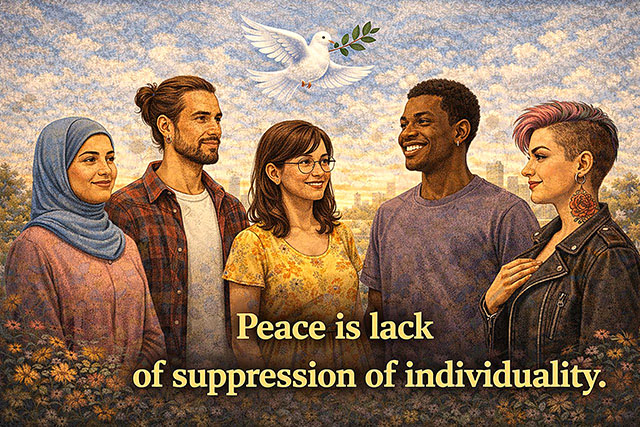
Another important element of the authoritarian system is the suppression of individuality. When people become as similar to one another as possible, when they are deprived of the right to be different and to express their own views, they become easier to manage and easier to discipline. This creates a situation in which a small group of people can control society and impose its will upon it.
Our House views its activities as a continuous search for and testing of different approaches to nonviolent social change. Some ideas prove successful, others do not. However, the very process of searching and public dialogue is an important part of social learning and the formation of a new culture.
Practice shows that forceful changes rarely lead to deep transformations. Violent changes of power often fail to alter the underlying role models and social relations. As a result, one surname in power may replace another, yet the lives of ordinary people do not become fundamentally better. Nonviolent change, by contrast, gives society the opportunity to reflect on its own experience, learn lessons, and gradually transform norms and values.
A good illustration of this process is the public discussion around the so-called «Article 328» – the drug-related article of the Criminal Code of Belarus. Starting in 2018, Our House worked to support teenagers and young people convicted under this article.
At that time, the organization encountered strong public hostility. Many people believed that such defendants did not deserve any protection. A widespread opinion held that drug users or distributors should be punished as harshly as possible.
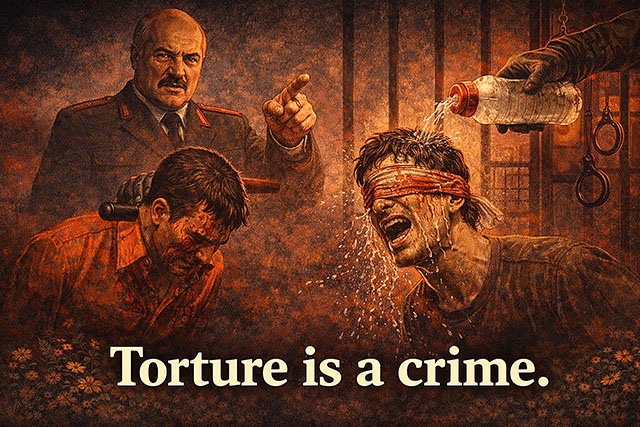
When Alexander Lukashenko publicly stated that everything should be done so that those convicted under Article 328 would «beg for death», this effectively meant the legitimization of torture and cruel treatment. A significant part of society at that time perceived such statements as normal.
However, after the events of 2020, when tens of thousands of Belarusians passed through repression, prisons, and torture, public attitudes began to change. This tragic experience became a difficult but important social lesson. Increasingly, people are coming to the conclusion that torture and cruel treatment are unacceptable under any circumstances. Even if a person has committed a crime, they must not be subjected to inhuman treatment.
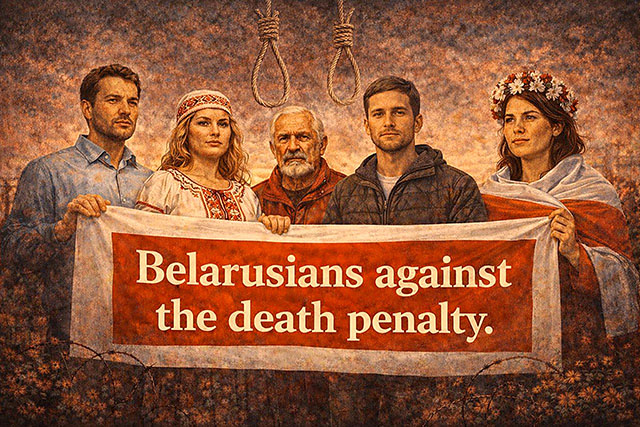
A similar evolution has occurred in attitudes toward the death penalty. In the mid-1990s, harsh statements about the necessity of executions could provoke mass support. Today, however, such statements increasingly raise concern and doubt.
People are beginning to ask questions about how independent the judicial system truly is and whether the death penalty might be used to eliminate unwanted witnesses or conceal crimes. In Belarusian public consciousness, there is a gradual understanding that even the most serious crimes cannot justify the arbitrary deprivation of life by the state.
Thus, Our House sees its activities as a long-term process of social development and public learning. We seek to create a space for searching for and testing ideas of nonviolent change, discussing complex moral issues, and building a culture of solidarity.
Our work shows that social values can change, even if this process takes years and is accompanied by serious trials. The foundation of our model for the future of Belarus – and in the broader regional context – is nonviolence, respect for human dignity, and the capacity for public dialogue.