Contribution to the Structured Dialogue on WFD Implementation in Lithuania: Transboundary Challenges in the Vilija–Neris River Basin
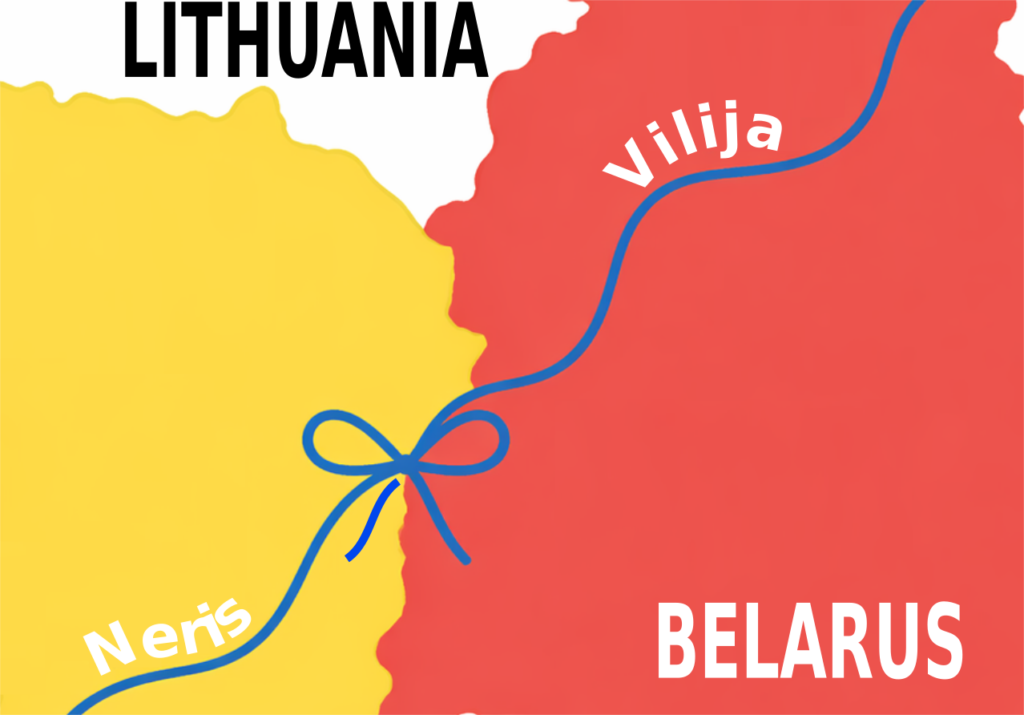
Transboundary gaps and upstream risks hinder Lithuania’s Water Framework Directive goals in the Vilija–Neris basin
Executive Summary
The Vilija River (known in Lithuania as the Neris) is a transboundary water system flowing from Belarus into Lithuania, where it joins the Nemunas River and ultimately drains into the Baltic Sea. Therefore, its environmental condition is shaped at the level of the entire river basin and depends on conditions both within the EU and beyond its borders.
Certain sections of the Neris River and adjacent territories in Lithuania are included in the Natura 2000 network – a system of protected areas established by the EU to safeguard vulnerable species and habitats. This increases the ecological significance of the river and requires a higher level of protection in the implementation of any management or infrastructure decisions.
Despite Lithuania’s formal compliance with the requirements of the EU Water Framework Directive (WFD), progress towards achieving environmental objectives remains limited. This is due not only to internal factors but also to transboundary upstream conditions, primarily in Belarus, where limitations in transparency, monitoring, and environmental control are observed.
The key problem lies in the transboundary governance gap, where differing institutional and regulatory systems within a single river basin prevent data comparability, effective pollution response, and comprehensive basin-level water management.
As a result, Lithuania, despite fulfilling the procedural requirements of the WFD, is objectively constrained in its ability to achieve good ecological status, as some key factors remain beyond its control.
This problem is exacerbated by additional pressures on the Neris River, including hydromorphological changes, infrastructure projects, and the emergence of a militarised approach to using the river as a transport and potentially strategic military corridor. Taken together, these factors increase the risk of environmental degradation, including in areas designated under Natura 2000.
Under these conditions, achieving WFD objectives requires not only national measures but also action at EU level, including stronger transboundary governance and the integration of upstream risks into water policy implementation.
1. Belarus: Absence of Independent, Objective, and Verifiable Monitoring on the Vilija
Country: Belarus and its political climate → implications for Lithuania
Problem formulation
In Belarus, water resource monitoring, including hydrological monitoring of rivers in the Nemunas basin (including the Vilija River), is carried out within a centralized state environmental monitoring system. Data collection and analysis are conducted by state authorities and affiliated scientific institutions, without institutionalised mechanisms for independent verification of environmental information1.
At the same time, publicly available information on the condition of water resources and the management of transboundary basins is limited and fragmented. Available materials are largely general or descriptive, while regular, detailed, and comparable reporting on water quality and the ecological status of transboundary water bodies is either absent from the public domain or significantly restricted2.
Additionally, international assessments indicate the need for further development and modernisation of Belarus’s water monitoring system, including improvements in data quality, comparability, and alignment with the approaches of the EU Water Framework Directive (WFD)3. It is also noted that the country’s water resource and environmental data management system remains under development and requires further improvement in terms of transparency, accessibility of information, and integration into international water governance practices4.
Limitations in transparency are further reinforced by institutional and political factors. Since 2020, opportunities for public oversight and civil society participation in the environmental sector in Belarus have significantly declined. Furthermore, Belarus’s withdrawal from the Aarhus Convention in 2022 – which establishes international standards for access to environmental information and public participation – has further restricted possibilities for independent verification of environmental data5.
Taken together, this creates a situation in which data on water conditions in the upstream part of the transboundary basin (the Vilija River) lack sufficient transparency, detail, and independent verifiability.
Risk for Lithuania and WFD implementation
This creates a structural constraint on the implementation of the EU Water Framework Directive in Lithuania. As a downstream state, Lithuania is required to assess the ecological and chemical status of water bodies at the level of the entire river basin. However, the absence of comparable, transparent, and independently verifiable upstream data reduces the reliability of such assessments and limits the ability to fully confirm the achievement of good ecological and chemical status.
Why this is a systemic problem
The problem is systemic in nature and is driven by the following factors:
the centralized and state-controlled nature of monitoring, including risks of data manipulation by Belarusian state structures
the absence of independent mechanisms for verification of environmental data in Belarus
limited public availability of detailed information
insufficient comparability of data with WFD approaches and requirements
Thus, this is not a case of isolated data gaps but rather structural characteristics of the monitoring system that create a persistent transboundary risk for water resource management in the Vilija–Neris basin.
2. Transboundary Pollution Without an Operational Early Warning and Response Mechanism
Country: Belarus and its political context → implications for Lithuania
Problem formulation
The Vilija River, which becomes the Neris on the territory of Lithuania, constitutes a single transboundary watercourse in which any pollution originating upstream on the Belarusian side may have downstream impacts on Lithuania, and subsequently on the Nemunas basin and the Baltic Sea6.
The transboundary Nemunas basin is characterised by the presence of significant pollution sources, including both point sources (industrial and municipal) and diffuse sources (primarily agricultural), as confirmed by international assessments7.
As early as 2014, issues related to coordination of monitoring, water quality assessment, and management of pollution sources in the Nemunas basin were addressed at the bilateral level between Belarus and Lithuania8. In subsequent years, international initiatives (including EUWI+ and UNECE) continued to support the development of transboundary cooperation, including data exchange, harmonisation of monitoring, and the development of a joint river basin management plan910.
However, available public sources do not make it possible to confirm that these processes have resulted in a stable and operational mechanism for early warning, real-time information exchange, and joint response to pollution incidents. On the contrary, elements such as early warning systems and harmonisation of monitoring programmes continue to be described as areas for further development rather than as a fully functioning and publicly transparent system11.
Taken together, this creates a situation in which potential upstream pollution is not accompanied by a sufficiently transparent, comparable, and demonstrably operational transboundary system for early warning and response.
Risk for Lithuania and WFD implementation
This creates a structural risk for the implementation of the WFD in Lithuania. As a downstream country, Lithuania depends not only on its own monitoring measures but also on timely access to comparable information on upstream pressures, potential pollution events, and their sources from Belarus.
In the absence of a clearly established and publicly verifiable mechanism for early warning and coordinated response, the detection of incidents, assessment of their scale, and implementation of timely measures are significantly constrained.
This undermines the basin-based approach underpinning the WFD, as water quality management at the scale of the entire transboundary basin cannot be considered fully effective if one of its key components – operational cross-border coordination in case of pollution – remains incomplete, insufficiently transparent, or not demonstrably functional in the public domain.
Why this is a systemic problem
The problem is systemic in nature and driven by the following factors:
the transboundary nature of the watercourse, where pollution originating in Belarus directly affects Lithuania
the absence of a publicly confirmed and clearly defined operational mechanism for early warning and joint response
the recognised presence of both point and diffuse pollution sources within the basin
differences in monitoring and water assessment systems between Belarus and Lithuania
Thus, this is not an isolated pollution incident but a structural deficiency in transboundary water quality governance in the Vilija–Neris basin.
3. Belarus: Astravets Nuclear Power Plant as a Source of Long-Term Water Risk in the Vilija Basin
Country: Belarus and its political context → implications for Lithuania
Problem formulation
The Astravets Nuclear Power Plant (BelNPP), located in Belarus near the Lithuanian border, is situated within the basin of the Vilija River, which flows into the Neris in Lithuania. This makes the plant not only an energy infrastructure facility but also a potential source of transboundary risk for a water system connected to the territory of the European Union12.
Materials from the Save Neris–Vilija campaign explicitly highlight that the Vilija–Neris basin connects the Belarusian upstream section with the Lithuanian downstream section, and that any contamination events within this system would propagate downstream – through the Neris, the Nemunas, and ultimately into the Baltic Sea13. In this context, the presence of nuclear infrastructure in the upstream part of the basin increases the importance of transparency in monitoring, data availability, and trust in transboundary information on water conditions.
An additional risk factor is that Lithuania has, for several years, officially emphasised unresolved concerns related to the safety of the BelNPP project and the need for continuous international monitoring. In particular, the Ministry of Foreign Affairs of Lithuania has stated that issues related to environmental impact assessment remain open, and that Belarus has not provided comprehensive responses to all concerns raised by Lithuania14. While this does not demonstrate actual water contamination, it does confirm the existence of a long-standing and internationally recognised dispute regarding transparency, impact assessment, and risk oversight.
Taken together, this creates a situation in which the potential influence of high-risk infrastructure upstream on a transboundary water system is not accompanied by a fully transparent, independently verifiable, and publicly trusted monitoring regime.
Risk for Lithuania and WFD implementation
This creates a risk for the implementation of the WFD in Lithuania. As a downstream country, Lithuania is required to assess the ecological and chemical status of water bodies at the scale of the entire river basin. However, the presence of a nuclear facility in the upstream part of the basin, combined with ongoing concerns regarding monitoring transparency and the completeness of international oversight, limits the ability to conduct a comprehensive assessment of potential transboundary impacts on water quality.
The issue is not limited to hypothetical accident scenarios but extends to a broader question: whether Lithuania can credibly confirm the sustained achievement of good chemical status if one of the most sensitive and potentially high-impact sources of risk is located upstream and remains subject to ongoing international concerns regarding transparency and supervision.
Why this is a systemic problem
The problem is systemic in nature and driven by the following factors:
the location of the BelNPP within the transboundary Vilija–Neris basin
the potential downstream propagation of contamination within a single hydrological system
long-standing international concerns regarding the adequacy of impact assessment and safety oversight
the absence of a fully transparent and independently verifiable monitoring regime trusted by downstream stakeholders
Thus, the issue is not a proven case of contamination but a structural vulnerability of a transboundary basin in which a high-risk facility is located upstream and affects Lithuania’s ability to fully demonstrate compliance with WFD environmental objectives.
4. Risk of Non-Transparent Activities and Uncontrolled Discharges in the Vilija Basin (Belarus)
Country: Belarus and its political context → implications for Lithuania
Problem formulation
On the territory of Belarus, the Vilija River and its associated water bodies are used for various types of economic activity, including industrial water use, agriculture (notably pig farming), and infrastructure-related processes that may generate pollution pressures on the water system.
In contrast to Lithuania, where pollution incidents in the Neris River may become the subject of public attention, investigation, and open discussion, comparable information in Belarus is largely absent from the public domain. This difference does not indicate the absence of environmental problems upstream but reflects fundamentally different levels of transparency and access to information. In the Belarusian context, potential pollution events – including unauthorised discharges or other impacts on the water system – may remain outside public scrutiny, independent verification and international oversight15.
Limited access to environmental information, the reduction of public oversight since 2020, and Belarus’s withdrawal from the Aarhus Convention in 2022 further increase the risk that potentially significant impacts on the water system may occur without timely detection and external verification.
An additional risk is illustrated by the fact that even in a context with more developed environmental control systems and active civil society (such as Lithuania), identifying pollution sources can be challenging. For example, in one case involving plastic pollution in the Neris River, the source of the discharge could not be conclusively identified despite investigations and public attention16. This highlights the inherent complexity of tracing pollution sources even under comparatively transparent conditions.
Furthermore, riverbed clean-up activities in Vilnius revealed a significant accumulation of anthropogenic waste (over 2 tonnes within a limited section), including materials capable of releasing pollutants over time17. This indicates that certain pressures on the water system may remain undetected and only become visible retrospectively.
In the Belarusian context, where independent oversight is limited, such risks carry a higher degree of uncertainty, and the nature, sources, and scale of anthropogenic pressures on the Vilija River remain only partially transparent.
Risk for Lithuania and WFD implementation
This creates a direct risk for Lithuania as a downstream country, as pollutants originating from economic activities upstream may enter the Neris River without timely detection or response.
In the absence of transparent and independently verifiable control over pollution sources upstream, Lithuania cannot fully account for all anthropogenic pressures affecting the water system. This reduces the effectiveness of water quality management and complicates the achievement of good ecological and chemical status under the WFD.
Why this is a systemic problem
The problem is systemic in nature and driven by the following factors:
the presence of potentially polluting economic activities within the basin
the absence of independent control and verification mechanisms
the inability to ensure timely detection of unauthorised discharges and diffuse pollution
limited access to environmental information and reduced public oversight
the inherent difficulty of identifying pollution sources even under more advanced monitoring systems
Thus, the issue is not only a lack of transparency but also a structural vulnerability, whereby potential sources of pollution may remain outside independent control and timely detection, creating a persistent transboundary risk for the Neris–Vilija water system.
5. Lack of a Comparable Transboundary Monitoring System (Belarus–Lithuania)
Countries: Belarus + Lithuania
Problem formulation
The Vilija–Neris River constitutes a single transboundary water body, the management of which, under the Water Framework Directive (WFD), should be carried out at the level of the entire river basin.
However, monitoring systems and water status assessment frameworks in Belarus and Lithuania are based on different methodological approaches, institutional models, and classification standards. This applies both to monitoring parameters and to the criteria used for assessing ecological and chemical status.
International assessments of the Nemunas basin point to the need for harmonisation of monitoring programmes, assessment methods, and classification systems among countries in the region18. At the same time, existing differences between national systems remain significant, limiting the comparability of data between upstream and downstream parts of the basin.
As a result, even where data are available on both sides of the border, their integration into a unified assessment framework remains limited, hindering the development of a coherent and comparable picture of the water system’s status.
Risk for Lithuania and WFD implementation
This creates a systemic constraint for the implementation of the WFD in Lithuania. The principle of river basin management requires the assessment of water status at the level of the entire basin. However, in the absence of comparable upstream and downstream data, it is not possible to ensure a complete and reliable assessment.
In particular, differences in monitoring methodologies and classification systems may lead to discrepancies in ecological status assessments, complicating both the identification of transboundary impacts and the verification of progress towards achieving good ecological and chemical status.
Why this is a systemic problem
The problem is systemic in nature and driven by:
differences in monitoring methodologies and water assessment approaches
the absence of full harmonisation between Belarus and Lithuania
limited comparability of upstream and downstream data
the inability to integrate data into a unified river basin assessment system
the influence of political and geopolitical factors in the region
Thus, the issue is not only a lack of coordination but also a structural incompatibility of monitoring systems, which undermines the implementation of the WFD at the transboundary level.
6. Pressure from Military Infrastructure and Militarisation on the Water System (Belarus + Lithuania)
Countries: Belarus + Lithuania
Problem formulation
Within the transboundary Vilija–Neris basin, military infrastructure is present on the territories of both Belarus and Lithuania, including training grounds, military zones, and other defence-related facilities. Such areas typically operate under restricted access and special governance regimes, which reduces transparency and limits the possibilities for independent environmental oversight.
The functioning of military infrastructure is associated with intensive land use, including the operation of heavy equipment, live-fire exercises, and physical alteration of landscapes. Military activities are not environmentally neutral. Scientific studies indicate that the production, use, and detonation of explosive materials can lead to contamination of soils, sediments, and water resources with chemical compounds such as TNT, RDX, and other toxic substances19. These substances may persist in the environment, migrate through soils, and enter both surface and groundwater systems, creating long-term sources of pollution20.
In addition, detonation processes may release chemical residues directly into water bodies and cause physical disruption of landscapes, further facilitating the transfer of pollutants into hydrological systems21.
An additional consideration is that military infrastructure in the region is not static. In Lithuania, for example, projects aimed at expanding and developing military training areas are ongoing, including in the Pabradė region, where the presence of military personnel and the intensity of land use are increasing22. This implies a growing potential environmental pressure within the Neris basin.
At the same time, information on the environmental impacts of military facilities, including monitoring data and results of environmental impact assessments (EIA/SEA), is in some cases not publicly available or significantly limited. This constrains the ability to assess their actual impact on water resources and limits opportunities for transboundary verification.
Taken together, this creates a situation in which part of the anthropogenic pressure on the water system within the transboundary basin may arise under conditions of reduced transparency and limited environmental oversight.
Risk for Lithuania and WFD implementation
This creates an additional risk for the implementation of the WFD, as the defence sector may partially operate outside standard mechanisms of transparency, monitoring, and public oversight provided for under environmental legislation.
In a transboundary context, this means that certain pressures on the water system may not be fully accounted for in water status assessments and river basin management planning. This reduces the reliability of ecological and chemical status assessments and complicates the achievement of good ecological and chemical status.
The absence of comparable and transparent information on the impacts of military infrastructure undermines the integrity of the river basin management approach, as water governance cannot be considered fully effective if certain categories of activities remain outside adequate assessment and control.
Why this is a systemic problem
The problem is systemic in nature and driven by the following factors:
the presence of military infrastructure within a transboundary river basin
intensive land use with potential physical and chemical impacts on the environment
scientifically established links between military activities and contamination of soils and water resources
restricted access to sites and environmental information
limited transparency regarding environmental assessments and monitoring
constrained opportunities for independent and transboundary verification
Thus, the issue is not about specific documented violations but about a structural vulnerability, whereby part of the anthropogenic pressure on the water system may remain outside full environmental regulation, monitoring, and transboundary control.
7. Lithuania: Use of the Neris River as a Logistical and Strategic Military Corridor
Country: Lithuania
Problem formulation
In Lithuania, the Neris River is considered not only as a natural ecosystem but also as a potential logistical, transport, and, in a broader context, strategic military corridor. This perspective is reflected in projects and public discussions, including statements by Lithuanian policymakers concerning the development of navigation, infrastructure, and the functional use of the river.
In particular, state initiatives and plans envisage the adaptation of the river for navigation between Vilnius and Kaunas, including riverbed dredging, deepening, development of port infrastructure, and expansion of the river’s transport function. It is explicitly noted that the river may be used not only for passenger and cargo transport but also in the context of military mobility23.
At the same time, at the level of municipal and infrastructure planning, the river is framed as an economic and transport resource, with emphasis on its potential for business development, tourism, and urban infrastructure24.
However, the scientific community and environmental experts warn that the implementation of such projects would require significant alteration of the natural riverbed, including dredging, removal of sediments, and changes to hydromorphology. According to these assessments, such interventions may lead to ecosystem degradation, loss of natural processes, and damage to habitats25.
Certain projects involving dredging and riverbed modification within Vilnius have already attracted criticism from environmental organisations, which emphasise that such works are carried out, including in Natura 2000 areas, and may affect fish spawning grounds and other sensitive ecosystem components26.
Moreover, in public discourse and analytical materials, the river is also considered as a potential element of strategic military infrastructure, including scenarios of its use as a transport or evacuation corridor in the context of crises or military threats27.
Risk for Lithuania and WFD implementation
This approach creates a risk for the implementation of the WFD, as decisions related to river deepening, regulation, and modification of the riverbed may be driven by functional use considerations rather than by the objective of preserving or restoring ecological status.
Hydromorphological interventions, including dredging, straightening, and alteration of natural river processes, may lead to deterioration of ecological status, which is contrary to the objectives of the WFD, including the achievement of good ecological status.
Additional pressure may arise where such decisions are justified by broader infrastructure, military, or strategic priorities (including transport and security), potentially lowering the priority of environmental requirements.
Why this is a systemic problem
The problem is systemic in nature, as it is not limited to individual projects but is linked to the emergence of a broader policy and governance logic in which the river is treated as an infrastructural and potentially military resource.
This is reflected in:
initiatives to develop navigation and transport use of the river
integration of the river into broader infrastructure and strategic policy frameworks (including military mobility)
projects involving dredging and riverbed modification
tensions between environmental requirements and infrastructure or defence-related interests
consistent critique from the scientific community and environmental organisations
Thus, the issue is not a single project but a broader policy framing in which the river is increasingly conceptualised as a functional corridor, creating long-term pressure on compliance with WFD requirements.
8. Hydromorphological Changes and Infrastructure Pressure on the Neris River (Lithuania)
Country: Lithuania
Problem formulation
Within the territory of Lithuania, the Neris River is subject to hydromorphological alterations associated with engineering interventions and infrastructure projects. These interventions are intended to modify key characteristics of the river, including depth, flow dynamics, and channel morphology, thereby directly affecting its natural state.
The implementation of such works, including projects aimed at dredging and deepening sections of the river in the Vilnius area, is documented in public sources and accompanied by ongoing discussions regarding their environmental implications28.
Scientific assessments emphasise that such hydromorphological changes may disrupt natural river processes, including sediment transport, flow structure, and ecosystem dynamics. In particular, alterations to the riverbed may lead to habitat degradation, reduced biodiversity, and disruption of aquatic life cycles29.
It is further noted that such interventions may affect sensitive natural areas, including sites designated under the Natura 2000 network, thereby increasing potential environmental risks30.
Risk for Lithuania and WFD implementation
Hydromorphological alterations are among the key factors influencing the achievement of good ecological status under the WFD. Interventions in river morphology may lead to deterioration of ecological status even in the absence of significant chemical pollution.
In the case of the Neris, ongoing infrastructure-related pressure creates a risk of failing to meet WFD environmental objectives, as changes to the physical characteristics of the river undermine its capacity to sustain natural ecosystems.
This is particularly critical in situations where such interventions have a cumulative effect and may intensify over time through multiple projects and initiatives.
Why this is a systemic problem
The problem is systemic in nature and driven by:
the regular application of engineering interventions in the river channel
the presence of infrastructure projects affecting hydromorphology
the cumulative effect of multiple alterations on ecological status
the interaction between infrastructure interests and environmental requirements
the risk of impacts on protected natural areas
Thus, the issue is not limited to individual interventions but reflects cumulative infrastructure pressure altering the physical state of the river and complicating the achievement of WFD objectives.
9. Formal Compliance with the WFD Without Full Achievement of Environmental Objectives (Lithuania)
Country: Lithuania (in the EU context)
Problem formulation
As an EU Member State, Lithuania formally complies with the requirements of the Water Framework Directive (WFD), including the development of river basin management plans, the implementation of monitoring programmes, and the submission of regular reporting.
At the same time, EU-level assessments indicate that the achievement of the Directive’s environmental objectives remains limited. According to the European Environment Agency (EEA), only around 40% of surface waters in the EU achieve good ecological status as defined by the WFD3132. This means that the majority of water bodies do not meet the established objectives, despite formal compliance with procedural requirements.
This points to a gap between institutional implementation and actual environmental outcomes.
Implications for WFD implementation
This gap indicates that even where an institutional and regulatory framework is in place, the objectives of the WFD are not fully achieved. This reduces the effectiveness of water policy and highlights limitations in existing approaches.
In the context of the Neris River, this is particularly relevant, as additional pressures – including hydromorphological changes, infrastructure development, and transboundary factors – further increase the risk of failing to meet environmental objectives.
Why this is a systemic problem
The problem is systemic in nature and driven by the following factors:
a gap between policy implementation (plans, reporting) and actual environmental outcomes
accumulated pressures on water systems (hydromorphology, infrastructure, transboundary factors)
limited effectiveness of measures aimed at achieving good ecological status
dependence of outcomes on factors beyond national control
Thus, the issue is not a lack of formal compliance with the WFD, but a structural mismatch between the Directive’s objectives and their actual achievement.
Structural Conclusion
The analysis demonstrates that the key risks to achieving the objectives of the Water Framework Directive (WFD) in the Vilija–Neris basin are systemic, long-term, and transboundary in nature.
The primary source of risk originates upstream, in Belarus, where water governance is characterised by limited transparency, lack of independent data verification, and insufficient alignment with EU approaches. This includes restricted access to environmental information, limited transparency regarding potential pollution sources, and the absence of demonstrably operational monitoring and response mechanisms.
At the same time, the formal responsibility for WFD implementation lies with Lithuania as an EU Member State. While Lithuania fulfils institutional and procedural requirements, it faces a range of constraints, including transboundary factors, hydromorphological pressures, infrastructure projects, military mobility considerations, and internal governance trade-offs.
The key issue is the transboundary governance gap, whereby upstream and downstream parts of a single river basin operate within different regulatory, institutional, military, and information systems. This results in a lack of comparable data, limited coordination, and an inability to ensure effective basin-wide water management, as required under the WFD.
As a result, a systemic effect emerges in which Lithuania, despite formal compliance with the Directive, is objectively constrained in its ability to achieve good ecological status without addressing or compensating for upstream challenges. The issue therefore extends beyond national implementation of the WFD and reflects a structural dependence of outcomes on transboundary conditions.
At the policy level, this implies that the identified challenges cannot be addressed solely through technical measures or national instruments. They require consideration and coordination at the EU–Member State level, including engagement with third countries, integration of transboundary risks into WFD implementation, and strengthening of cooperation mechanisms in transboundary river basins.
1 Как проводят гидрологический мониторинг | Новости | Министерство природных ресурсов и охраны окружающей среды Республики Беларусь
6 How EU public funds risk enabling environmental degradation and militarisation in the Neris river basin – Our House/Наш дом
10 UNECE facilitates negotiation of a technical protocol on transboundary water cooperation between Belarus and Lithuania | UNECE
13 How EU public funds risk enabling environmental degradation and militarisation in the Neris river basin – Our House/Наш дом
14 Astravets NPP project requires permanent international monitoring | Ministry of Foreign Affairs of the Republic of Lithuania
19 Effects of military training, warfare and civilian ammunition debris on the soil organisms: an ecotoxicological review | Biology and Fertility of Soils | Springer Nature Link
23 VU scientists propose removing the Neris from the list of waterways of national importance – MadeinVilnius.lt
27 The Neris on the Frontline: When a River Becomes a Battleground Between War, Nuclear Risk and Nature – New Leaf
31 Europe’s state of water 2024: the need for improved water resilience | Publications | European Environment Agency (EEA)
About The Author