Transboundary Pollution Without an Operational Early Warning and Response Mechanism
Lack of coordinated early warning systems exposes Lithuania to unmonitored upstream pollution risks.
Country: Belarus and its political context → implications for Lithuania
Problem formulation
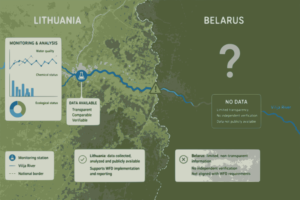
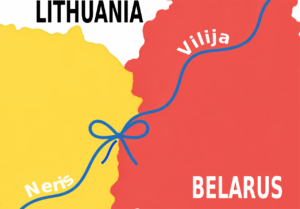
The Vilija River, which becomes the Neris on the territory of Lithuania, constitutes a single transboundary watercourse in which any pollution originating upstream on the Belarusian side may have downstream impacts on Lithuania, and subsequently on the Nemunas basin and the Baltic Sea.
The transboundary Nemunas basin is characterised by the presence of significant pollution sources, including both point sources (industrial and municipal) and diffuse sources (primarily agricultural), as confirmed by international assessments.
As early as 2014, issues related to coordination of monitoring, water quality assessment, and management of pollution sources in the Nemunas basin were addressed at the bilateral level between Belarus and Lithuania. In subsequent years, international initiatives (including EUWI+ and UNECE) continued to support the development of transboundary cooperation, including data exchange, harmonisation of monitoring, and the development of a joint river basin management plan.
However, available public sources do not make it possible to confirm that these processes have resulted in a stable and operational mechanism for early warning, real-time information exchange, and joint response to pollution incidents. On the contrary, elements such as early warning systems and harmonisation of monitoring programmes continue to be described as areas for further development rather than as a fully functioning and publicly transparent system.
Taken together, this creates a situation in which potential upstream pollution is not accompanied by a sufficiently transparent, comparable, and demonstrably operational transboundary system for early warning and response.
Risk for Lithuania and WFD implementation
This creates a structural risk for the implementation of the WFD in Lithuania. As a downstream country, Lithuania depends not only on its own monitoring measures but also on timely access to comparable information on upstream pressures, potential pollution events, and their sources from Belarus.
In the absence of a clearly established and publicly verifiable mechanism for early warning and coordinated response, the detection of incidents, assessment of their scale, and implementation of timely measures are significantly constrained.
This undermines the basin-based approach underpinning the WFD, as water quality management at the scale of the entire transboundary basin cannot be considered fully effective if one of its key components — operational cross-border coordination in case of pollution — remains incomplete, insufficiently transparent, or not demonstrably functional in the public domain.
Why this is a systemic problem
The problem is systemic in nature and driven by the following factors:
the transboundary nature of the watercourse, where pollution originating in Belarus directly affects Lithuania
the absence of a publicly confirmed and clearly defined operational mechanism for early warning and joint response
the recognised presence of both point and diffuse pollution sources within the basin
differences in monitoring and water assessment systems between Belarus and Lithuania
Thus, this is not an isolated pollution incident but a structural deficiency in transboundary water quality governance in the Vilija–Neris basin.
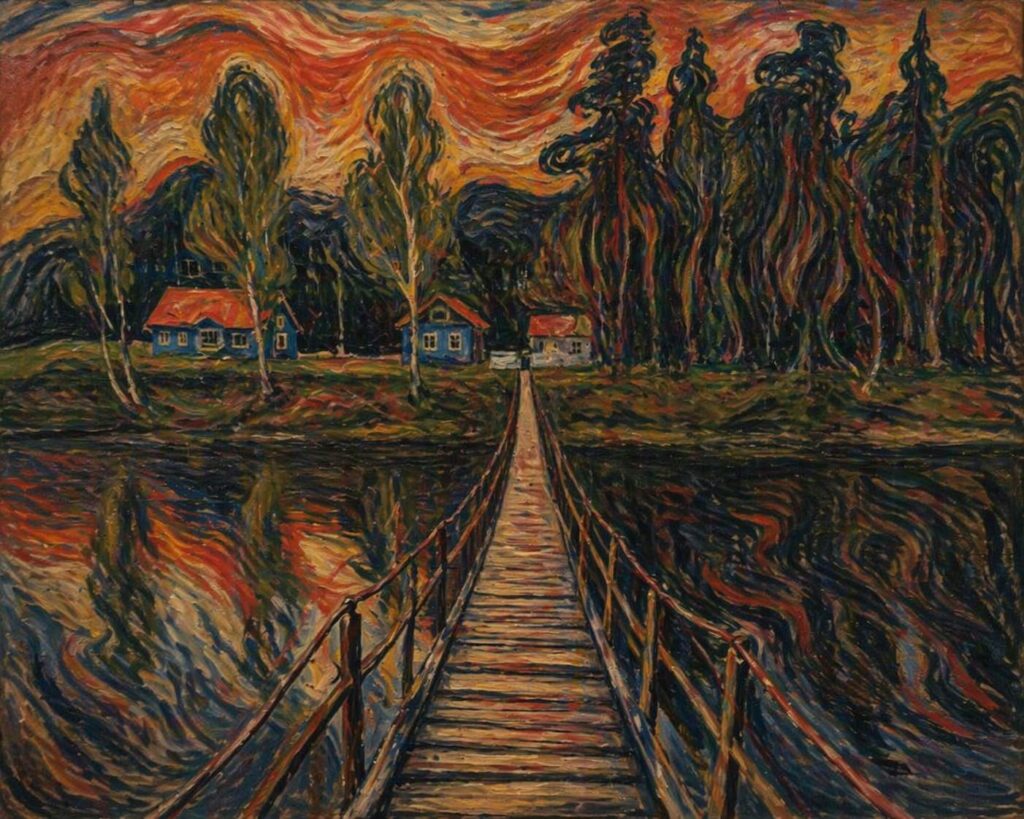
The illustration depicts a real object — a bridge over the Neris River on the border between Lithuania and Belarus, known as the Buivydžiai Suspension Bridge. We have only slightly stylized the photo in the spirit of a well-known apocalyptic aesthetic.
About The Author