“Le Chant du loup” – France announces it will no longer act in the spirit of the New START treaty and will cease informing others about the number of combat-ready nuclear devices in its possession

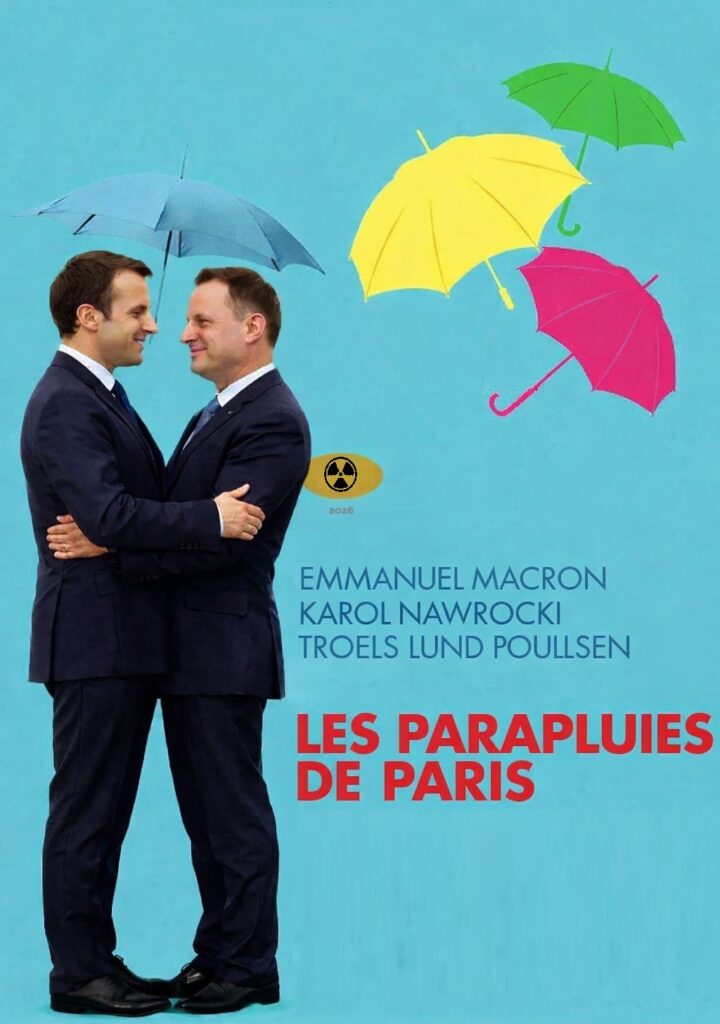
Furthermore, France proposes that this now delightfully indeterminate number of warheads might be distributed across Europe, thereby creating what is described as a nuclear umbrella.
Le Chant du loup is a film about a French submarine that loses contact with the mainland—and, it would seem, with reality as well. Its crew must decide whether to launch a nuclear strike against their adversaries. Such a strike would trigger the Third World War, and the fate of global peace ultimately rests with the submarine’s captain.
At present, Emmanuel Macron appears to be drifting into a similar role: that of the captain of a somewhat unmoored submarine. Consider, for a moment, the metaphor of the umbrella. The word is singularly ill-suited to nuclear weapons. Weapons are not umbrellas. If anything, recent history suggests that complex military hardware behaves less like a protective canopy and more like a crate of matches accidentally left in the hands of children.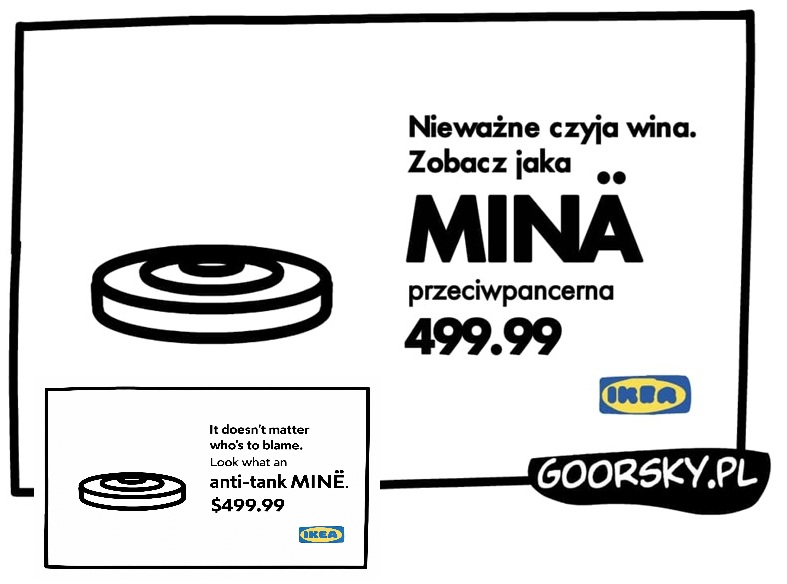
One might recall—not a cinematic submarine—but a thoroughly real episode involving Polish anti-tank mines which, due to a logistical mishap, travelled not to a military base but to IKEA.
True, France never signed the New START treaty. Nevertheless, at a moment when the agreement has already expired, it seems remarkably imprudent to declare an end to transparency and to drift toward an arms-race posture. Such declarations could easily encourage both Russia and the United States not even to contemplate further limitations or negotiations.
Let us extend the thought experiment. If nuclear weapons were to appear in Poland or Denmark—countries that have recently hinted at such possibilities—several extremely hazardous facilities would inevitably follow. These would require entirely new infrastructure, specialised security, and experts who have never previously existed within those national systems. They would also require vast sums of money.
And governments, as history repeatedly demonstrates, have a curious habit of economising on precisely the things least visible to the naked eye: safety.
An umbrella this is not. It resembles, rather, the distribution of matches to children.
Meanwhile, just beyond the European Union’s eastern border, in Belarus, two similar “children” are busily constructing sites for Russian nuclear weapons: one intended for tactical systems and the other for strategic ones.
Few would seriously doubt that launch platforms for missiles such as Oreshnik—derived from the Rubezh (SS-X-31), itself derived from Yars (SS-29), which in turn evolved from Topol-M (NATO designation SS-27 Sickle B)—possess a strategic nuclear capability. No one questions the strategic nature of the Topol-M missile.
One wonders, therefore: if Russian missiles and French aircraft begin steadily raising the temperature of the strategic environment, might there eventually appear a captain who presses the button without reflection?
A similar moment once arose in the Soviet Union. It was not cinema but reality. On that occasion, a thoughtful officer—Colonel Petrov—chose not to press the button.
Whether such thoughtful individuals remain plentiful today is, perhaps, the only truly important question.
Context: what changed in the world after 5 February 2026
The New START treaty (СНВ-III) between the United States and Russia expired on 5 February 2026. From that moment onward, both sides may theoretically retrieve warheads from storage—roughly 5,000 each—and mount them on delivery systems without the previously agreed ceiling of 1,550 deployed warheads.
Verification under New START had already deteriorated during the COVID period and was never fully restored amid subsequent tensions. In practical terms, no one now knows with precision how many warheads are currently deployed.
France: existing posture and recent developments
France never signed the treaty and has historically possessed far fewer operational warheads—somewhere between 300 and 500. However, the number it could assemble in the near term is uncertain. Macron has ruled out external oversight.
France has no land-based intercontinental missiles. Its deterrent relies on four Triomphant-class ballistic missile submarines and a number of Rafale aircraft equipped with cruise missiles.
France emphasises full national control: the decision to use nuclear weapons rests solely with the President of France.
France has spoken of joint exercises, allowing partners to train alongside nuclear forces, and potentially deploying aircraft to air bases in other countries.
Separately from such deployments, France speaks of a certain umbrella—and not the Cherbourg variety.
About The Author