Manufacturing Consent: Military Service Propaganda and the Breakdown of Conscription in Belarus

Escalating propaganda masks structural failure of compulsory military service among Belarusian youth
By 2025, state policy in the field of conscription in Belarus is increasingly accompanied by aggressive and intrusive public propaganda of military service. The intensification of such campaigns by senior officials and law-enforcement bodies indicates a systemic crisis of the conscription model, in which military service is no longer perceived by young people as socially desirable or self-evident.
It is indicative that the need to «increase the attractiveness of military service» is regularly articulated at the highest level. Public statements emphasize problems of conscript motivation, young people’s unwillingness to undergo compulsory military service, and the need to “work with the consciousness” of future conscripts. The very presence of such rhetoric demonstrates that the coercive nature of conscription increasingly requires ideological and media-based compensation.
Problematic mechanisms of propaganda
Firstly, the state employs mass media campaigns aimed at creating a positive and “fashionable” image of the army. Military service is presented through entertainment and pop-cultural formats, which sharply contrasts with the real conditions of compulsory service and underscores the artificial nature of the constructed image.
Secondly, propaganda deliberately blurs the boundary between voluntary choice and obligation. The army is portrayed as a space for self-realization, a «school of life», and a social elevator, while risks, restrictions of rights, the impossibility of refusal, and consequences for the health and mental condition of servicemen are silenced.
Thirdly, the public campaign relies on visual and emotional pressure, rather than informed choice. The use of images of «success», «masculinity», and «heroism» substitutes for discussion of the actual rights of conscripts and alternative forms of service, which are largely absent from official discourse.
Fourthly, propaganda of military service is closely linked to the previously described militarization of children and adolescents. In conditions where the army ceases to be attractive to young adults, the state shifts its focus to younger age groups, forming loyalty and habituation to military logic long before conscription age.
Public statements on the need to “increase the attractiveness of the army”
In 2025, representatives of state bodies, including the highest political leadership and the Ministry of Defence, through their public actions demonstrated the need to intensify efforts to form a positive attitude toward compulsory military service, which in fact constitutes an acknowledgement of its declining public attractiveness. The state operates under conditions of personnel shortages and increases conscription activity through administrative measures and propaganda.
Media campaigns of the Ministry of Defence
In 2025, the Ministry of Defence disseminated video materials and visual advertising aimed at promoting an image of military service as prestigious and desirable. The campaigns actively used elements of show culture and entertainment aesthetics, contrasting with demonstrably depersonalized images of soldiers, which underscores the propagandistic nature of these materials.
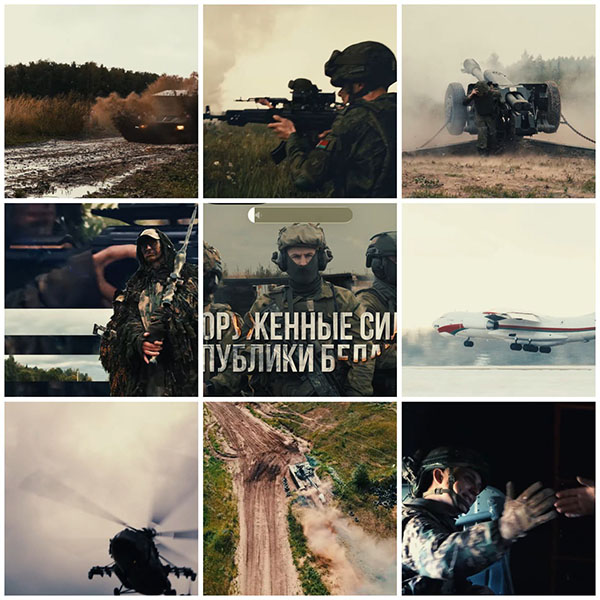
Video materials of the Ministry of Defence of Belarus disseminated in 2025 as part of campaigns promoting military service are constructed using cinematic aesthetics. They consistently depict scenes of firing automatic weapons, the operation of artillery, the movement of armored vehicles across rough terrain, flights of combat aircraft and helicopters, as well as close-up shots of fully equipped servicemen in combat conditions. The visual sequence emphasizes physical strength, armament, and combat readiness, while completely lacking any explanations regarding the legal status of servicemen, conditions of service, or the rights of conscripts.
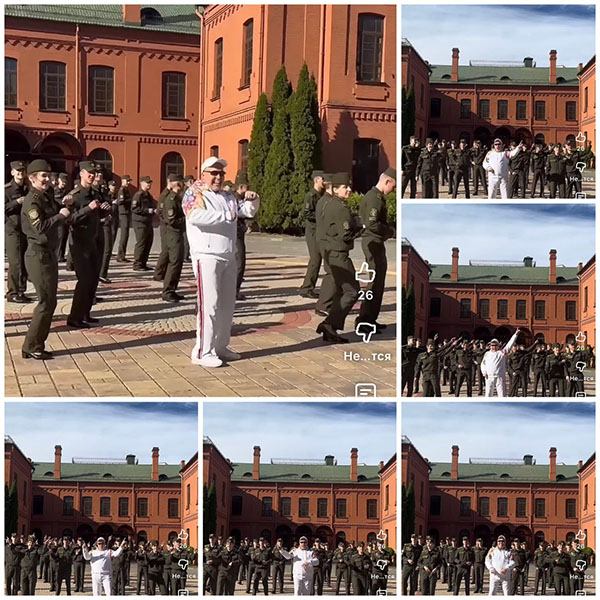
In another video used as part of the campaign to “increase the attractiveness of military service,” military themes are presented through an entertainment format involving a pop performer well known in Belarus. The performer, shown in a demonstratively civilian image, interacts with a group of cadets, while choreography and mass movement serve as the main visual device. The soldiers appear as a depersonalized group, whereas the civilian artist occupies a dominant position in the composition, underscoring the symbolic and propagandistic nature of the material.
Promotion of military service through “patriotic” leisure and public events
Military service is promoted not only through direct advertising, but also through mass «patriotic» events, festivals, and campaigns addressed, among others, to adolescents and young people of pre-conscription age. These formats increase pressure on future conscripts by presenting military service as a social norm, and refusal as a deviation.
About The Author