

A Russian deserter who fled the war in Ukraine and requested asylum in Lithuania spent nearly six months continuously deprived of liberty before being returned to Russia. His subsequent arrest raises serious concerns about the handling of asylum claims and compliance with international protection obligations.
The public version of the case is based almost entirely on comments by VSAT (the Lithuanian State Border Guard Service) and the Migration Department, published by LRT (Lithuanian Radio and Television). According to this version, a Russian citizen deserted, fled Russia after refusing to take part in the war against Ukraine, illegally crossed the border, requested political asylum in Lithuania, was convicted of illegally crossing the Lithuanian border, then spent almost six months continuously deprived of liberty, after which, while still deprived of liberty, he allegedly voluntarily withdrew his asylum application and agreed to return to Russia. After being transferred to the Russian side, he was arrested, and his further fate is unknown.
This sequence contains several direct inconsistencies and major gaps: the legal basis for the renewed deprivation of liberty after 19 May has not been disclosed; the conditions under which the withdrawal of the asylum application was obtained have not been disclosed; the mechanism for verifying voluntariness has not been disclosed; the assessment of the risk after return has not been disclosed; and the case itself was publicly treated by the Lithuanian authorities primarily as a case of illegal border crossing, rather than as the case of a Russian deserter who had fled the war and requested protection and political asylum in Lithuania.
According to the Telegram channel “Slovo zashchite”(“A Word for the Defence”),1 which was the first to report on this case:
A young Russian citizen deserted directly from the war against Ukraine.
He came to the Lithuanian-Russian border without an international passport and requested asylum in Lithuania.
On 15 June 2026, he was deported from Lithuania to Russia.
After crossing the border into Russia, he was arrested by the Russian authorities. His further fate is unknown.
What LRT and the Lithuanian Authorities Confirmed2
LRT published an article presenting the position of Lithuanian state authorities, which raised even more questions than it clarified.
The Lithuanian State Border Guard Service confirmed the fact that the Russian citizen had been returned to the Russian Federation.
What the Lithuanian Authorities Did Not Confirm
VSAT stated that it could neither confirm nor deny information that the man had been a serviceman in the Russian army and had deserted from the front.
A VSAT representative stated that, for the service, this person was regarded as an individual who had illegally crossed the state border, which appears highly unusual in the case of an asylum seeker. According to the representative of the service, in such cases a person’s profession, education, and other personal information are not relevant to VSAT, which also appears highly unusual in the case of a person seeking political asylum.
This means that the Lithuanian border guard service publicly confirmed that the case was considered primarily as a case of illegal border crossing, rather than as the case of a potential deserter who had fled participation in the war and was in need of international protection. His application for political asylum was ignored and was not properly examined by Lithuanian state authorities.
What Meduza Reported3
The publication states that Lithuanian authorities deported a Russian military deserter to Kaliningrad on 15 June after he had fled from the front in Ukraine.
After crossing the border into Russia, he was arrested by the Russian authorities, and his further fate is unknown.
Lithuania treated his case exclusively as a case of illegal border crossing and did not examine his application for political asylum on the merits.
Timeline Established on the Basis of Media Publications in the Case of This Russian Deserter
29 December 2025
The man was detained after illegally crossing the Lithuanian-Russian border from the Russian side.
December 2025 – May 2026
Proceedings concerning the illegal crossing of the state border were conducted against him.
The court found him guilty and sentenced him to four months and twenty days of imprisonment.
Period of Serving the Sentence
According to VSAT’s version, the asylum application was submitted while he was already serving his sentence, approximately four months after his detention.
19 May 2026
The man was released from prison.
In reality, he did not regain his freedom: immediately after his release, he was handed over to the border guard service and placed in the Foreigners Registration Centre.
Around 21 May 2026
Two days after his release, the court again authorised his detention until the second half of August.
1 June 2026
According to VSAT’s version, the man submitted a written request to discontinue the examination of his asylum application and expressed a wish to return to Russia.
8 June 2026
The Migration Department discontinued the examination of the asylum application and adopted a decision to return the man to Russia.
15 June 2026
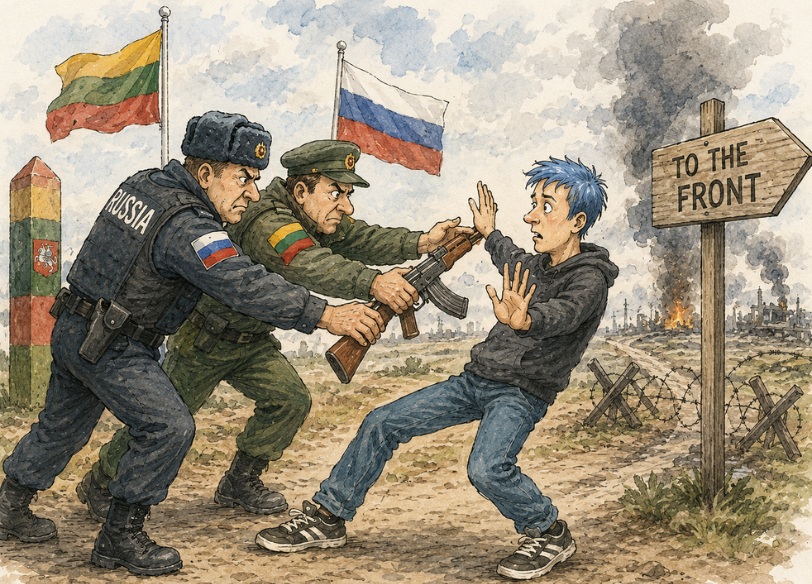
The man was handed over to the Russian side through the Kybartai border crossing point.
After 15 June 2026
After returning to Russia, the man was arrested by the Russian authorities. His further fate is unknown.
Identified Inconsistencies and Gaps in the Official Version of the Lithuanian Authorities
-
The version that the asylum application was submitted late is inconsistent with the known purpose of the deserter’s flight.
According to “Slovo zashchite” (“A Word for the Defence”), the Russian citizen deserted and fled directly from the war against Ukraine, came to the Lithuanian-Russian border without an international passport, and requested political asylum. LRT reproduces precisely this initial version.
At the same time, VSAT states that the asylum application was submitted only four months after his detention, when he was already serving his sentence.
These two versions are difficult to reconcile. If a person crossed the border from Russia without documents while fleeing participation in the war, the published facts reveal no other rational purpose than seeking international protection and political asylum. The publications do not explain what happened immediately after his detention, what statements the person made at that time, and how they were recorded. For a human rights assessment, this is a central gap.
Unfortunately, “Our House” has documented cases in which VSAT officers failed to take into account and register written asylum applications submitted by Belarusian conscientious objectors. In this regard, there are objective grounds to believe that a similar situation may have occurred in this case as well: the Russian deserter requested asylum in Lithuania, but his application may not have been properly recorded and registered by VSAT officers.
-
The deserter’s case was publicly handled as a case of illegal border crossing.
VSAT directly stated that it could neither confirm nor deny that the man was a Russian serviceman and had deserted from the front. The same service indicated that, for VSAT, he was a person who had illegally crossed the state border, and that the case was considered precisely in that capacity. This means that, publicly, the case was classified as a border violation, although the initial information and the asylum context indicated a possible case of desertion and persecution upon return. The publications contain no information indicating that, before the deportation, the risk of persecution specifically as a deserter was separately examined, or that his application for political asylum was examined on the merits.
-
From 29 December to 15 June, the person was effectively not free for a single day.
The public timeline is as follows: detention on 29 December; a criminal case and deprivation of liberty; release on 19 May; immediate transfer to the border guards; placement in the Foreigners Registration Centre; two days later, renewed detention by court order; on 1 June, a statement requesting the discontinuation of the examination of the asylum application; on 8 June, a decision on return; on 15 June, transfer to the Russian side. This was not a series of independent episodes, but almost six months of continuous deprivation of liberty.
This is a key fact for assessing all subsequent actions and signed documents.
-
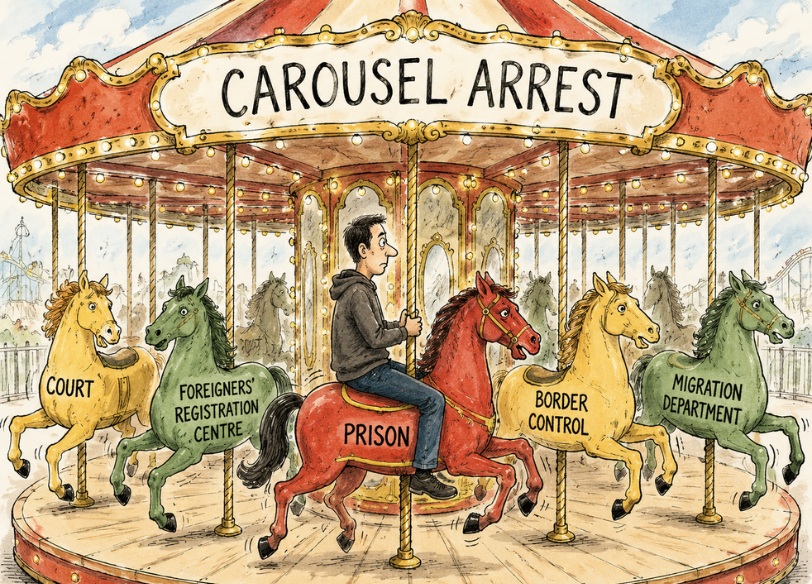
The renewed deprivation of liberty after 19 May has not been substantively explained and shows signs of “carousel arrest”.
LRT writes that, after being released from prison, the man was handed over to the border guards, placed in the Foreigners Registration Centre, and two days later the court again placed him in detention until the second half of August. Meduza and Bytes Europe additionally note that the agency did not disclose on what charge or on what grounds the repeated detention took place. The public version contains neither the court decision, nor its reasoning, nor the specific legal basis for the new deprivation of liberty. This is one of the main gaps in the case.
Such a situation of repeated deprivation of liberty on the same or closely related grounds falls within the definition of “carousel arrest” — a practice well known to “Our House” and to other independent human rights defenders in Belarus and Russia. Activists and human rights defenders of “Our House” have themselves been victims of carousel arrests in Belarus and know this practice not from publications or accounts, but from their own experience.
Carousel arrest is the repeated deprivation of liberty on the same or closely related grounds, where a person is formally transferred from one regime of detention to another, but in fact remains continuously deprived of liberty without any real release. Often, no new charges are brought against the person, no new circumstances of the case are communicated, and the deprivation of liberty itself continues through the constant change of procedures and agencies.
The danger of carousel arrest lies not only in the deprivation of liberty as such, but also in its extremely severe psychological impact. A person prepares for release, expects to regain freedom, makes plans, and attaches certain hopes to this. However, immediately before release or immediately after it, the person is detained again and placed under another regime of detention. This practice destroys the sense of legal certainty, creates a feeling of complete helplessness before the state apparatus, and forms in the person the belief that their imprisonment may continue indefinitely. This is precisely why many human rights defenders regard carousel arrests as one of the most cruel forms of psychological pressure and inhuman treatment.
In this case, the signs of carousel arrest are sufficiently clear. After serving his sentence on 19 May, the Russian deserter was not released, but was immediately handed over to the border authorities and placed in the Foreigners Registration Centre. Two days later, he was again placed in detention by court order. There was no actual period of freedom between these decisions. As a result, the person remained continuously deprived of liberty, despite the change in legal grounds and in the state structures responsible for his detention.
Additional signs include the almost six-month period of continuous deprivation of liberty, repeated deprivation of liberty without any publicly known new circumstances, withdrawal of the asylum application while in renewed detention, and consent to return to the state from which he had previously fled, risking his freedom and safety.
Each of these circumstances taken separately does not yet prove unlawful pressure. However, taken together, they correspond to the characteristic features of carousel arrest, require an independent investigation, and cast serious doubt on the fully free and independent nature of the decisions that the Russian deserter made after almost six months of continuous deprivation of liberty.
-
The version of a “voluntary” withdrawal of the asylum application is not confirmed by the conditions in which the withdrawal was obtained.
VSAT claims that, on 1 June, the man voluntarily wrote a statement requesting the discontinuation of the examination of his asylum application and expressed a wish to return home; on 8 June, the Migration Department discontinued the examination of the application and adopted a decision on return; the man was then familiarised with the documents and did not wish to appeal the decision. The publications contain no information about the presence of an independent lawyer, the quality of interpretation, the person’s psychological state, whether the consequences of withdrawal and refusal to appeal were explained to him, or whether voluntariness was verified outside conditions of isolation. After almost six months of continuous deprivation of liberty and “carousel arrests”, a statement by a Lithuanian state authority that the deserter acted “voluntarily” is not, in itself, sufficient confirmation of voluntariness for us.
-
Absence of an individual examination of the asylum application
Particular attention should be paid to the fact that VSAT itself effectively acknowledges the absence of any examination of the Russian deserter’s personal circumstances. According to VSAT’s position, the agency did not have information about who exactly the applicant was, what his circumstances and background were, and what possible risks he would face in the event of deportation back to Russia.
However, such a statement raises serious questions regarding compliance by Lithuanian state authorities with the procedure for examining an asylum application. The Russian deserter submitted an application for political asylum, which means that the competent authorities of Lithuania were obliged to conduct an individual assessment of his identity and the circumstances of the case, including an analysis of possible risks of violations of his rights in the event of return.
Even the subsequent withdrawal of the application cannot serve as proof that such an assessment was not required at all. If VSAT states that it did not examine the applicant’s identity and did not conduct the relevant analysis, this may indicate that the asylum application was in fact not examined on the merits and that there had been no intention to examine it. In other words, a well-founded question arises as to whether the obligation under Lithuanian law and European conventions to conduct an individual examination of the case and assess the risks was fulfilled, or whether the application was ignored without the necessary review being carried out.
-
The risk after return was not theoretical.
After the man was transferred to the Russian side, according to Meduza, he was arrested by the Russian authorities, and his further fate remained unknown. LRT conveys the same information in the form of a report about his detention after return.
This means that the risk of adverse consequences after deportation materialised immediately, rather than remaining at the level of a hypothesis. The publications contain no information as to whether a separate assessment of this risk was conducted before the return and whether it was reflected in the case file.
Conclusions Based on the Totality of the Facts
The public materials indicate not merely a disputed migration story, but a case with several systemic ruptures.
The first rupture is between the nature of the flight and the official version of a late request for protection.
The second is between the completion of a criminal sentence and a new deprivation of liberty without a disclosed basis.
The third is between almost six months of deprivation of liberty and the assertion of an allegedly voluntary withdrawal of the asylum application.
The fourth is between the initial information about desertion and the public position of the authorities that the case was treated exclusively as an illegal border crossing.
The fifth is between the absence of a public risk assessment and the fact of immediate arrest after return to Russia.
At the same time, this is no longer only about the fate of one Russian deserter.
It concerns the emergence of a worsening pattern of treatment of Russian and Belarusian deserters, conscientious objectors, and asylum seekers in Lithuania, including prolonged detention, repeated deprivation of liberty after serving a sentence — that is, “carousel arrests” — refusal to examine their applications for protection, and the subsequent transfer of people to the state, followed by arrests in Belarus and Russia — that is, in the very countries from which they had attempted to obtain protection in Lithuania.
Given the gravity of the consequences for the deserter himself, who was arrested in Russia after deportation, this situation requires immediate attention from human rights organisations, independent journalists, the Lithuanian legal community, international human rights structures, and institutions engaged in the protection of refugees and compliance with human rights standards.
An independent examination of the circumstances of this case is necessary not only to establish the fate of this particular person, but also to understand whether the practice of Lithuanian state authorities complies with Lithuania’s international obligations in the field of refugee protection, the right to asylum, and the prohibition of forced return of people to countries where they may face persecution.