From Leisure to Training: Militarized Youth Camps in Belarus, 2025

Youth camps operate as transitional institutions, normalizing military discipline and pre-conscription training for minors.
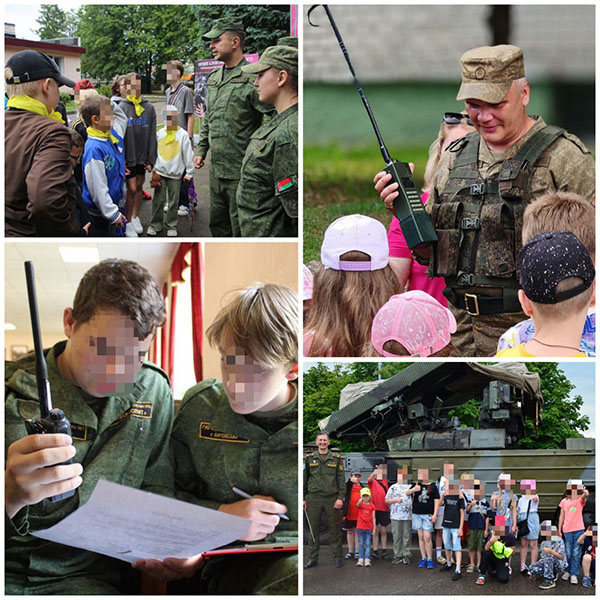
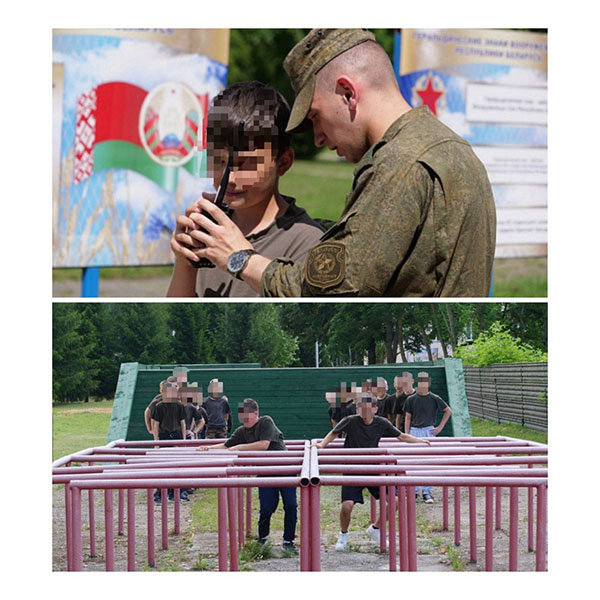
On 12 July 2025, it was reported that day camps and round-the-clock residential camps were operating in which servicemen conducted training sessions on the disassembly and assembly of assault rifles, radio communications, and fitting of military equipment.
Prolonged Stay of Schoolchildren on the Premises of Military Units
On 22 July 2025, a third summer session of a round-the-clock residential camp was documented on the premises of the 83rd Engineering and Airfield Regiment; the report the report emphasized the long-term regularity of this practice («13th consecutive year») and the large-scale involvement of children.
Military-patriotic clubs in Belarus constitute a key connecting element between school education and subsequent forms of military coercion. Unlike one-time events or camps, clubs create a long-term, institutionally embedded environment in which adolescents are consistently and progressively involved in military and military-ideological logic over the course of several years.
Through the club system, the state simultaneously addresses several objectives: it forms sustained loyalty to the armed forces, accustoms adolescents to military discipline and hierarchy, and reduces the likelihood of refusal of military service by replacing the right to choice with a pre-constructed trajectory of «normal» growing up. Participation in clubs is presented as voluntary and prestigious; however, in practice it becomes a continuation of mandatory school-based «patriotic education» in a more rigid and targeted form.
Problematic Mechanisms
Firstly, military-patriotic clubs are institutionally linked to active military and law-enforcement bodies, rather than to civilian educational or sports organizations. Clubs are established on the basis of military units and subdivisions of the Ministry of Defence and the Ministry of Internal Affairs, which means that their activities are directly dependent on departmental ideology and objectives.
Secondly, clubs function as a space for early pre-conscription training, where adolescents are introduced not only to symbolism and history, but also to practical elements of military service: drill discipline, tactical training, elements of weapons handling, obedience to orders, and acceptance of hierarchy as a norm. These practices cultivate habituation to military logic long before conscription age.
Thirdly, the club system lacks an alternative framework. Participation does not involve discussion of the right to refuse military service, civilian forms of service to society, or non-militarized models of patriotism. On the contrary, military service and readiness for it are established as the only acceptable form of «responsible civic behavior».
Fourthly, clubs perform the function of a personnel reserve: they are embedded in a vertical structure that logically continues through camps, training assemblies, reserve service, and subsequent conscription. As a result, participation in a club becomes part of a continuous process, from which it becomes increasingly difficult for an adolescent to exit without conflict with the system.
Club based at a military unit (Zhodino)
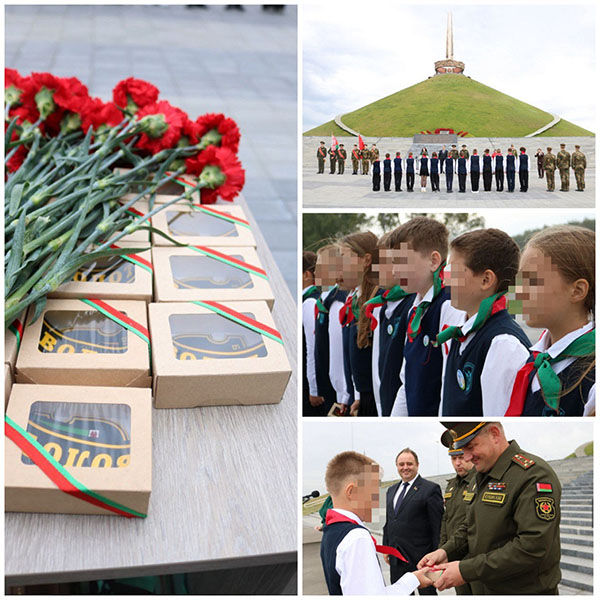
On 16 September 2025, students of Gymnasium No. 1 in the city of Zhodino took part in a ceremonial induction into the military-patriotic club «Volot», established on the basis of the 65th Automobile Brigade. The event was held in a ritualized format with the participation of a representative of the Ministry of Defence responsible for ideological work. The format itself emphasizes the institutional link between the club and an active military unit, as well as the use of military symbolism and ceremonial practices in the involvement of minors.
Network of clubs under the auspices of the Ministry of Internal Affairs
In 2025, the Ministry of Internal Affairs officially reported that more than 200 military-patriotic clubs operate under the auspices of internal affairs bodies and the internal troops of the Ministry of Internal Affairs, involving over six thousand children and adolescents. Thus, the militarization of the adolescent environment is carried out not only through the Ministry of Defence, but also through a law-enforcement body with repressive functions, which expands the scope and institutional density of this system.
Normative formalization of the club system
In 2025, the activities of military-patriotic clubs received direct normative formalization within the system of the Ministry of Defence. Orders and programmatic documents were published on the official portal of the Ministry of Defence, including Order of the Minister of Defence No. 1221 of 25 August 2025, as well as the «Programs of the Military-Patriotic Club of the Armed Forces of the Republic of Belarus». In the explanatory materials, the purpose of the clubs is defined as fostering «loyalty to the Motherland» and readiness to carry out tasks to defend the Fatherland, with the target group identified as minors aged 15–17.
Link to subsequent forms of coercion
Thus, military-patriotic clubs function not as an optional form of leisure activity, but as a structural element of the pre-conscription system. They create a transition from school militarization to more rigid formats—camps, training assemblies, and reserve service—forming a situation in which refusal to participate in the military system becomes socially and psychologically difficult even before conscription age is reached.

This article includes a frame from Pink Floyd – The Wall (dir. Alan Parker, 1982), used for purposes of commentary and analysis
About The Author