A United Nations Without Democratic Integrity: Why Belarus Must Not Be Entrusted with Gatekeeping Civil Society Access
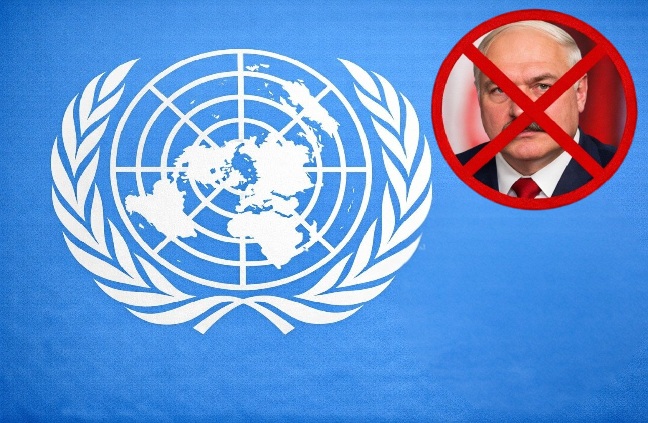
In April 2026, Member States of the United Nations Economic and Social Council will elect new members to the Committee on Non-Governmental Organizations — a body whose mandate extends far beyond administrative procedure and, in practice, determines which voices from civil society are granted meaningful access to the United Nations system.
This Committee is not merely a technical mechanism.
It constitutes, in effect, the institutional gateway through which civil society must pass in order to engage with the UN.
Yet, increasingly, this gateway is shaped — and in some cases controlled — by States whose domestic records reflect systemic restrictions on civic space, suppression of independent organisations, and persecution of human rights defenders.
The Committee as a Gatekeeper of Global Civic Participation
The Committee on NGOs exercises a decisive influence over:
- the granting of ECOSOC consultative status;
- the ability of organisations to participate in UN meetings and processes;
- the broader accessibility of international advocacy platforms.
Accordingly, its composition is not a neutral matter of institutional rotation.
Rather, it directly determines which segments of global civil society are afforded recognition, visibility, and voice — and which are excluded.
Belarus: A Fundamental Contradiction
Within the Eastern European regional group for the 2027–2030 term, the candidates include:
- Belarus
- Estonia
- Ukraine
While this configuration formally constitutes a competitive slate, the essential concern is not procedural adequacy, but substantive legitimacy.
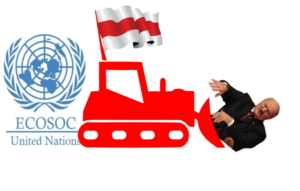
The Government of Belarus, under the Lukashenko regime, has:
- dismantled the independent civil society sector through the liquidation of thousands of organisations;
- criminalised human rights activity;
- arbitrarily detained and imprisoned large numbers of individuals on politically motivated grounds;
- designated human rights defenders and civic actors as «extremists» or «terrorists»;
- systematically eradicated the conditions necessary for free civic participation.
Notwithstanding this record, Belarus is now seeking election to a body that determines the admissibility of civil society actors at the United Nations.
Such a development represents not merely an inconsistency, but a profound institutional contradiction, whereby a State that suppresses civil society domestically is positioned to regulate civil society internationally.
Procedural Deferral as a Tool of Exclusion
The implications of this contradiction are not theoretical; they are reflected in practice.
Belarusian human rights organisations have, over a period extending to several years, sought to obtain ECOSOC consultative status. In numerous cases:
- applications are neither approved nor formally rejected;
- instead, they are subjected to repeated rounds of «additional questions»;
- decisions are systematically deferred across successive sessions.
These procedural dynamics cannot be understood as neutral administrative processes.
Rather, they constitute a pattern of prolonged and deliberate exclusion, effectively denying organisations access to international advocacy while avoiding formal accountability for rejection.
A delay of four years does not reflect due diligence.
It reflects structural obstruction.
The Structural Deficit of Non-Competitive Elections
This situation is further exacerbated by the prevalence of so-called «closed slates», whereby:
- the number of candidates equals the number of available seats;
- elections proceed without genuine competition;
- Member States are deprived of meaningful choice.
Such arrangements, which have been documented and challenged by civil society initiatives, undermine:
- accountability;
- transparency;
- institutional credibility.
Where electoral processes are reduced to formalities, the resulting bodies cannot claim democratic legitimacy.
Democratic Deficit Within the United Nations System
In the absence of:
- genuine competition among candidates;
- rigorous evaluation of States’ human rights records;
- accountability for decisions affecting civil society access;
the principle of democratic governance is eroded — not only at the national level, but within the multilateral system itself.
Consequently, the United Nations risks compromising its foundational commitment to inclusivity and participation.
The Case for a Political «Yellow Card»
The candidacy of Belarus necessitates a clear and principled response.
A State that:
- systematically suppresses independent organisations;
- persecutes those who engage in human rights work;
- obstructs access to international mechanisms;
cannot, without undermining the integrity of the system, be entrusted with regulating civil society participation at the United Nations.
At a minimum, this requires:
the rejection of Belarus’s candidacy to the Committee on NGOs.
Such a measure would not constitute political exclusion, but rather the application of basic normative coherence.
Implications for the Multilateral System
The issue at stake extends beyond any single State.
If:
- governments that restrict civic space are empowered to determine access to international fora;
- civil society actors are excluded through procedural manipulation;
- gatekeeping functions are exercised without accountability;
then the United Nations ceases to function as a genuinely universal platform for dialogue.
Required Actions
In order to restore integrity to the process, the following steps are essential:
- Ensure competitive elections
Regional groups must nominate more candidates than available seats. - Promote informed voting
ECOSOC Member States should base their decisions on objective assessments of States’ records in supporting civil society and protecting civic space. - Prevent conflicts of principle
States with documented patterns of repression should not be entrusted with gatekeeping roles over civil society participation. - Address procedural abuses
Systematic deferrals and administrative obstructions must be recognised and challenged as mechanisms of exclusion. - Strengthen collective advocacy
Civil society organisations should coordinate efforts to raise awareness, engage diplomatic actors, and promote accountability within the system.
Conclusion
The elections to the Committee on NGOs represent a critical test of democratic integrity within the United Nations.
At present, this test is being compromised.
Unless the international community acts to ensure:
- genuine competition;
- transparency of process;
- accountability of decision-making;
access to the United Nations will continue to be mediated by those who restrict it most severely.
This is not a procedural concern.
It is a question of principle.
Hashtags
#OpenTheDoors2NGOs
#CloseDoorsToRepressiveRegimes
#StopLukashenko
#UnitedNations
#ECOSOC
#ECOSOC_for_OurHouse
#CivicSpace
#HumanRights
#Belarus
#OurHouse

About The Author