When War Reaches the River
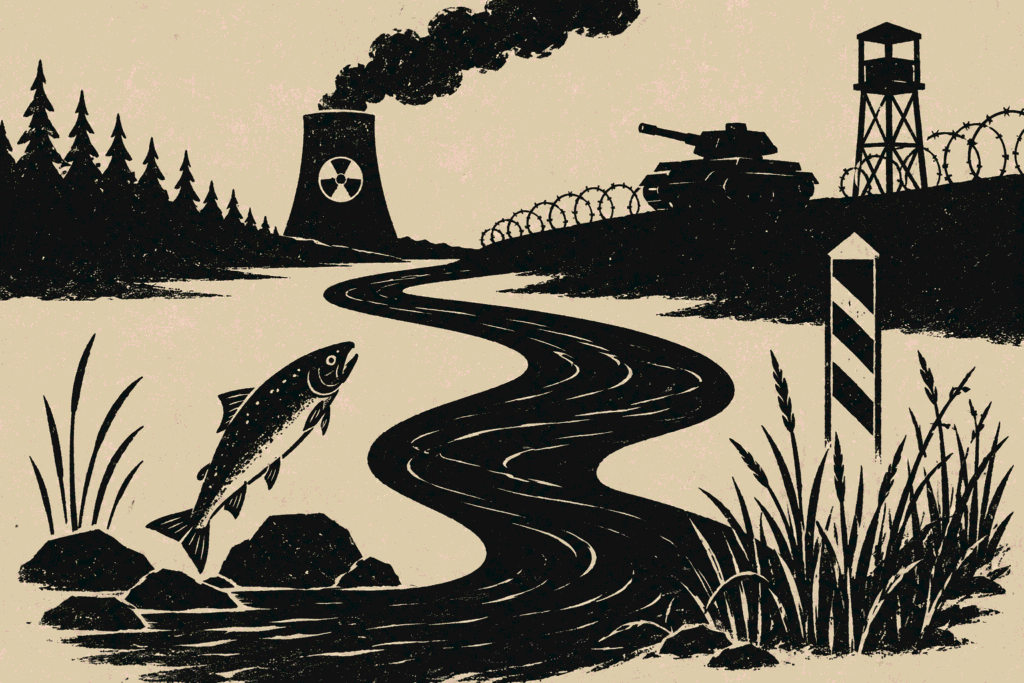
How Militarisation Is Changing the Environment of Eastern Europe — Long Before the First Shot Is Fired
By Olga Karach
When we talk about the environmental consequences of war, we usually picture scenes of destruction: burning forests, bombed-out industrial facilities, contaminated soil, damaged dams, oil on the water, mines scattered across fields that once produced crops. These are the visible traces of war, and that is precisely why we notice them.
But the ecological history of a war begins much earlier. Often, it begins long before the first shot is fired.
It begins when we gradually start looking at a landscape through different eyes. When it is no longer seen primarily as a place where life exists, but as strategic space. A road is no longer simply a road, but a potential military transport route. When we look at a bridge, suddenly it matters not only which places and people it connects, but also what military loads it can carry. A forest becomes a potential area of military operations. And even a river that has flowed through the same landscape for centuries can suddenly be assigned new tasks: it is expected to serve as a transport route, an obstacle, a line of defence or an evacuation corridor.
In Eastern Europe today, we can watch this transformation taking place almost in real time.
Russia’s war against Ukraine has shaken the security order of the entire region. Belarus is closely integrated into Russia’s military infrastructure; at the same time, Lithuania and other countries on NATO’s eastern border are expanding their defence and evacuation planning. The political reasons for this are understandable and plain to see. What is discussed far less is what this new security logic does to landscapes and ecosystems.
Nature, after all, does not respect national borders.
A particularly vivid example is a river I have known for many years. In Belarus, it is called the Viliya; in Lithuania, the Neris.
One River, Two States
The Viliya/Neris is around 500 kilometres long. It rises in Belarus, crosses the border into Lithuania, flows through the heart of Vilnius, and joins the Nemunas near Kaunas, which eventually carries its waters into the Baltic Sea.
Politically, this river now crosses one of the tensest borders in Europe. Ecologically, that border does not exist at all.
Water needs no visa. Sediments do not pass through border control. Fish do not know when they have left Belarus and entered the European Union. And potential pollutants cannot be stopped by a border sign either.
That is precisely where the problem lies.
Parts of the Neris Valley in Lithuania belong to Natura 2000, the European network of protected areas. The river landscape provides a habitat for numerous species and is also one of the remaining migration routes for wild Baltic salmon and sea trout. Many of their historic migration routes within the Nemunas river basin have long since been blocked by dams. This makes the stretches of the Viliya/Neris that still flow freely all the more valuable. Their importance ends neither at the Lithuanian nor at the Belarusian border.
In this story, the salmon is not simply a beautiful fish that conservationists like to put on the covers of their brochures. It is a biological indicator of the river’s health. As long as a fish can travel from the Baltic Sea through this river system, swimming hundreds of kilometres upstream to reach its spawning grounds, something very fundamental in this ecosystem is still working.
If one day the salmon no longer returns, that will not only be bad news for the salmon. It will tell us something about the condition of the entire river.
The Nuclear Shadow
But if we follow the Viliya upstream, we encounter a different reality.
Just a few dozen kilometres from the Lithuanian border, near Astravyets, stands the Belarusian nuclear power plant. An ecologically valuable, transboundary river system therefore lies at the same time within the immediate sphere of influence of nuclear infrastructure.
The Viliya plays an important role in supplying water to the power plant. As long as everything operates as it should, this connection remains invisible to most people. In the event of serious contamination, however, the same geography would suddenly become crucial. The river would be one of the natural routes along which pollutants could be carried downstream.
And the Belarusian-Lithuanian border would be completely meaningless.
The water would keep flowing. To Vilnius, on to the Nemunas, and from there eventually into the Baltic Sea.
The story becomes even more complicated when we consider not only the operation of a nuclear power plant, but what remains afterwards. Belarus is developing infrastructure for the disposal of radioactive waste. The timescale of this problem therefore extends far beyond the operating life of a reactor. A radioactive legacy forces us to think not in electoral cycles or even decades, but in centuries — and in some cases, beyond.
In a politically unstable region in particular, this is not simply a technical question of energy policy. It is also a political question, and a rather uncomfortable one: Who will guarantee the safety of such facilities during future political crises, military conflicts or, in the worst-case scenario, a collapse of state structures?
We do not know what the political map of Eastern Europe will look like in fifty or a hundred years. We do not know what governments will be in power, where the borders will lie, or what alliances will exist.
The river will probably still be there.
And it will continue doing what rivers have done for thousands of years: carrying downstream whatever enters its waters.
When a River Becomes Infrastructure
On the Lithuanian side of the border, the story looks different — but here, too, the fear of a possible war is changing the way people look at the river.
Since Russia’s attack on Ukraine, Lithuania and its neighbours have significantly strengthened their military and civilian crisis preparedness. Roads are no longer assessed solely by how quickly they can take people from one city to another. Increasingly, railway lines and bridges are also judged by whether they would be suitable for military transport in an emergency. “Military Mobility” has become an established term in European security policy.
And at some point, the Neris appeared in this new security landscape as well.
In Vilnius, there has been public discussion about using the river as a possible evacuation route in the event of a crisis. On a map, the idea initially seems surprisingly logical: the Neris flows westwards from Vilnius, away from the Belarusian border. If the roads were blocked or overwhelmed, why not use the river as well?
There is just one problem: a natural river landscape is not a water highway.
To make the Neris reliably navigable, it might be necessary to alter precisely those features that still make it a natural river today: rapids and other natural obstacles, sediments, shallows, parts of the riverbed. What looks like an inconvenience from the perspective of logistics may be vital to a river and the creatures that live in it. A rock in the water may be an obstacle to a boat. For a fish, that same rock may be part of its habitat.
This small example reveals a much larger conflict, one that is likely to remain with us in Europe for a long time.
The more we prepare our landscapes for a possible war, the easier it becomes to treat environmental law and nature conservation as irritating obstacles. Suddenly, the question arises whether, in dangerous times, we can still “afford” Natura 2000, natural riverbeds or protected habitats.
But perhaps the problem lies in setting them against each other in the first place. A functioning ecosystem is not a luxury alongside security. It is itself part of security.
Nature Is Not Reserve Land for War
Militarisation changes more than roads, bridges, rivers and landscapes. Often almost imperceptibly, it also changes the language we use to talk about them.
A river becomes a “corridor”. A bridge becomes “dual-use infrastructure”. A landscape acquires “strategic significance”. Forests, wetlands and floodplains increasingly appear on maps as areas expected to perform a particular function in an emergency.
At first, this may sound like merely technical language. But this language is not neutral.
As long as we regard a river as an ecosystem, we have to justify why we want to interfere with it. Once that same river is regarded primarily as infrastructure, the logic shifts. Suddenly, those who want to protect it are the ones who have to explain why a natural river course should be allowed to stand in the way of what is presented as a more urgent security requirement.
This is precisely where the debate becomes difficult for peace movements.
It would be too easy to dismiss the security fears of people in Lithuania, Poland or other countries in the region as exaggerated or irrational. I live in this region myself. The war in Ukraine is not an abstract possibility. Russian aggression is real. The military integration of Russia and Belarus is real. And of course governments have to think about how to protect their populations if the situation deteriorates further.
A real threat forces us to respond. But it does not relieve us of the responsibility to ask whether that response actually makes sense and whether, in the end, it really creates greater security.
Especially in times of war, there is one thing a democratic society must not forget how to do: ask questions. Which measures are truly necessary? Which are actually effective? What damage do they themselves cause? And what exactly are we trying to protect when we speak of security?
Because a society can prepare militarily for one catastrophe while damaging other foundations of its own security.
The Environment Remembers Wars Longer Than We Do
Anyone who wants to understand how long the ecological history of a war can last need only follow the water from the Neris — through the Nemunas and on into the Baltic Sea.
There, part of Europe’s wartime history still lies on the seabed.
After the Second World War, large quantities of chemical munitions and other weapons were dumped in the Baltic Sea. At the time, it probably seemed like a practical solution: the war was over, the weapons had to go somewhere, and the sea was vast.
Eighty years later, the problem is still there.
Containers are corroding. Munitions lie on the seabed. Wrecks and other hazardous objects do not disappear simply because the generation that left them there is long gone. Today, the countries around the Baltic Sea are still dealing with decisions made by people decades ago, under completely different political circumstances.
HELCOM, the intergovernmental commission for the protection of the Baltic Sea, continues to assess these risks. Regional projects are examining how dumped munitions can be monitored and where their recovery might be both possible and safe.
We humans have precise dates for when a war begins and when it ends. We put them in history books. We commemorate anniversaries of armistices and peace treaties. For nature, those dates do not work in the same way.
For nature, a war can continue for decades, even generations.
Metal continues to corrode. Heavy metals remain in the soil. Chemical warfare agents do not cease to be dangerous because a border has shifted or a peace treaty has been signed. Mines can outlive the soldiers who laid them — and sometimes even the states in whose name they were laid.
Perhaps one reason we so easily underestimate the ecological consequences of war is that our political sense of time is much shorter than nature’s.
Nature, in any case, carries the traces of our wars far longer than our political debates last.
The War in Ukraine Is Making Visible What We Have Long Overlooked
What war does to a landscape can be seen today in Ukraine with frightening clarity.
Industrial facilities are hit, soils are mined and damaged by military use, forests burn, and water infrastructure is destroyed. The destruction of the Kakhovka Dam in 2023 demonstrated in particularly dramatic fashion how quickly the loss of a single major piece of infrastructure can alter the geography of an entire region — not merely for weeks or months, but potentially for decades.
Naturally, neighbouring countries are drawing their own conclusions. They are considering how roads, bridges, railways and other infrastructure would function in an emergency. Given the war, this is understandable.
What would be dangerous is to conclude that as much of the landscape as possible should now be made usable in advance for the next war.
The crucial question should therefore be framed differently: How do we protect people without damaging the natural systems on which those same people depend in the long term?
An intact river is also security infrastructure — we simply do not usually call it that.
Wetlands store water and reduce flood risks. Forests protect soils and water systems. Biodiversity makes ecosystems more resilient. A natural river can respond to floods, periods of drought and other extreme events differently from a waterway that has been straightened, deepened and subjected to technical control.
In the face of climate change, all of this is becoming more important, not less.
If we destroy natural protection mechanisms in order to prepare ourselves better for a possible military catastrophe, we face a peculiar risk: we may protect ourselves against one danger while creating new vulnerabilities elsewhere.
Security Must Not Mean Preparing Everything for War
For me, this story is not abstract. I live between these two sides of the river myself.
I am a Belarusian human rights and peace activist, and today I live in Lithuania. In Belarus, I knew this river as the Viliya. Here, it is called the Neris.
For people, these are two names, two countries and, today, two very different political realities. For the river, it is simply the same journey to the sea.
The Neris knows neither NATO nor Russia. It knows nothing of the border between Belarus and the European Union, and it does not distinguish between democracy and dictatorship. Water carries onward whatever enters it, regardless of which side of the border it came from.
Radioactive substances do not become less dangerous depending on whether they come from a politically allied or hostile country. The same is true of industrial pollution. And when a habitat is destroyed, the political legitimacy of the government that made the decision does nothing to lessen that ecological loss.
This emphatically does not mean blurring political and moral distinctions. Democracy and dictatorship are not the same. Russia as the aggressor and Ukraine as the country under attack are not the same. For someone from Belarus in particular, it would be absurd to pretend that these differences do not matter.
But water does not follow our political categories.
That is precisely the challenge of transboundary ecosystems: we have to take responsibility for something that escapes the boundaries we draw.
The worse political relations between states become, the more difficult such cooperation becomes. At the same time, it becomes all the more necessary. A river cannot wait until two governments are ready to speak to each other again.
Ecological responsibility must therefore not end where our political solidarity ends or our political hostility begins.
Peace Also Needs an Ecological Dimension
I am continually struck by how naturally we separate peace policy from environmental policy.
Debates about peace tend to focus on security, disarmament, military threats and international relations. Rivers, forests, biodiversity, water quality and climate usually end up in a different political category, as though these issues had little to do with one another.
War makes no such distinction.
It strikes people and landscapes at the same time. It destroys homes and water pipes, industrial facilities and soils, human communities and natural habitats. And when the guns eventually fall silent, what remains is not only the dead and wounded, displaced people and traumatised societies. There are also mines, contaminated soils, destroyed forests, damaged waterways and dangerous industrial and military legacies.
That is why it is not enough to understand peace simply as the absence of gunfire.
A peace in which people live on destroyed or contaminated land, drink unsafe water and must deal for generations with the ecological legacy of war is not yet a sustainable peace.
We therefore cannot wait until a war is over before talking about its environmental consequences. They must already form part of decisions about military infrastructure and security. This is particularly important for transboundary rivers and for nuclear risks in politically tense regions. It is precisely there that transparency and international oversight are needed. And a protected natural area should not become a strategic reserve simply because the fear of war is growing.
The Viliya/Neris could become a small but highly revealing European test case.
On one side of its river basin lies an authoritarian state with a nuclear power plant and a radioactive legacy whose story will extend far into the future. On the other lies an EU and NATO state that, for understandable reasons, is considering how to protect its population in the event of military conflict.
And between them flows a river that was made for neither: neither nuclear policy nor military logistics.
In the end, I keep coming back to the salmon.
Wild Baltic salmon still swim from the sea through the Nemunas into the Neris and onwards into the Viliya to reach their spawning grounds. They follow a route far older than Belarus and Lithuania, older than the European Union and NATO, older than our present-day borders and conflicts.
In Europe today, we talk a great deal about how we should prepare for the next war. Given what is happening in Ukraine, that is understandable.
We should think at least as seriously about what we want to survive the next war.
Whether the salmon will still be able to find this ancient route upstream in the future may at first sound like a rather small ecological question. In reality, it leads directly into the much larger question of what we mean when we speak of security and peace.
Written especially for pax_zeit magazine, Germany.
About The Author