Not everyone who does not want to fight wants peace
Why conscientious objection is only the beginning of demilitarisation
This article is not an attempt to provide a ready-made answer. Rather, it is an invitation to think more deeply about what we actually mean by antimilitarism when war ceases to be an abstract possibility and becomes an immediate political reality. The past four years of working with Belarusian, Russian and Ukrainian conscientious objectors, deserters and people trying not to return to the army have increasingly led me to a question that once seemed almost theoretical: is refusing to participate in war, by itself, enough for us to speak of demilitarisation?
In peacetime, it is easy to defend a person’s right not to kill. It becomes much more difficult when a state genuinely needs soldiers, society lives within a logic of threat, and refusal of military service is no longer understood as the exercise of a right but as a rejection of a collective duty. It is precisely at this point that we discover how universal our own convictions really are.
The first paradox is geopolitical. A Belarusian who refuses to serve the Lukashenko regime fits comparatively easily into the European image of a politically persecuted person. A Russian who does not want to participate in the aggression against Ukraine is likewise seen as someone making a morally understandable choice. But when a Ukrainian man says, “I too do not want to take up a weapon and kill,” his refusal is often placed within a completely different moral framework: not freedom of conscience, but duty to the state; not a human right, but a civic obligation. And then an uncomfortable question arises: is conscientious objection a human right – or only the right of a citizen of the “wrong” army?
There is a second geopolitical paradox, no less painful. European societies may support refusal of military service by Belarusians and Russians at the level of political rhetoric. Yet that support suddenly becomes much more complicated when the same person appears not as a symbol of resistance to a regime, but as an asylum seeker and says: “I cannot return because I do not want to serve.” It is precisely here that the morally understandable figure of the conscientious objector is often transformed into the “wrong” conscientious objector – a person whose motives are scrutinised, whose sincerity is doubted, and whose claim to protection appears far less self-evident than abstract solidarity with them.
This is particularly important for our region. In four years of war, we have not even succeeded in making this first step reliable: in practice, the right to conscientious objection for people fleeing conscription and military service from Belarus, Russia or Ukraine remains recognised only to a very limited extent. For that very reason, I would not romanticise refusal of military service as a completed act of antimilitarism. We have not yet even learned to guarantee a person the elementary right to say, “I will not kill,” without making their legal status depend on their passport, country of origin and the political usefulness of their refusal.
Yet even if this first step is achieved, it does not solve the problem completely. There is another paradox – an internal one, located not in the state but within the conscientious objector themselves.
In our work with Ukrainian men who are in Europe and do not want to return for military service, we encounter a contradiction that is uncomfortable to discuss precisely because it disrupts familiar moral categories. A person’s personal refusal to participate in war does not necessarily mean a rejection of militarist logic. Someone may consistently defend their own right not to take up a weapon while at the same time supporting further militarisation, demanding more military aid, treating an armed solution as the only possible one, and assuming that others should fight.
This is not a reason to deny that person the right to refuse. On the contrary: the right not to be forced to kill must not depend on how philosophically coherent, morally elevated or politically convenient a person’s motivation is. They may be a religious pacifist, a convinced antimilitarist, someone who is afraid of dying, or someone who does not want to lose their family, their job or their ordinary life. All these motivations are different. But the human right not to be forced to participate in killing must not be granted only to those capable of formulating a flawless pacifist manifesto.
At the same time, we should not turn every person who evades military service into a pacifist simply because they evade it. Not everyone who does not want to go to war wants peace. Sometimes they simply do not want to go to war themselves.
This is where the more difficult debate begins for the antimilitarist movement itself. If our work ends at the moment when a person has managed to evade mobilisation, cross a border and obtain legal protection in Germany, Lithuania or another European country, we have solved the problem of that particular person, but we have changed almost nothing in the militarist logic that produces the next war.
We are becoming increasingly convinced that helping a person leave the army and helping a person leave the logic of war are not the same thing. The first step can be legal: recognise the right to refuse, provide protection, do not return a person to a place where they will be forced into military service. The next step, however, is social, political and cultural: helping people stop seeing violence and war as normal instruments of politics, stop dividing people into those who deserve protection and those whom it is permissible to coerce, and stop reproducing in civilian life the binary scheme of “our own – the enemy”.
Conscientious objection is therefore the beginning of demilitarisation, not its completion. More than that: it is only the first step that we in our region have been trying to take for four years and still cannot regard as guaranteed. After it comes a much more difficult task, for which European societies still barely have a language.
How can we help people leave not only the army, but also the logic of war? This question immediately connects conscientious objectors with deserters and former combatants. At first glance, these are completely different groups: one person refused to put on a uniform, another left the army, a third fought for several years and only then returned to civilian life. But after the war, Europe will face all of them at the same time – and not only them. It will face millions of people whose ideas of security, violence, trust, masculinity, the enemy, justice and what is permissible have been shaped by war.
We often speak of a future peace agreement as though the end of hostilities automatically meant the return of peace. But a war does not end when the weapons fall silent. It does not end when a person takes off a uniform. And it does not end when a person refuses to put that uniform on in the first place. A war ends when its logic ceases to determine our ideas of security, the enemy, violence and acceptable ways of resolving conflict.
This is why demilitarisation cannot be reduced either to disarming an army or to an individual’s refusal of military service. It is a process in which society itself has to change: schools, media, political language, ideas of heroism, the way we speak about the adversary, our attitude to dissent, and our ability to see a human being not as a resource for war but as an autonomous bearer of rights.
For the peace movement, this creates an uncomfortable but necessary self-examination. It is not enough to defend those who do not want to fight. We must protect their right to refuse even when we do not share their motivation, while at the same time not confusing the legal right to conscientious objection with an already completed antimilitarist transformation. Otherwise, we will either make moral purity a condition of protection, or present mere evasion of mobilisation as if it were already a fully developed culture of peace.
The real work begins between these two extremes. It requires us to accept a person as they are, give them the right not to kill, and at the same time create a space in which they can rethink the logic of war itself. Not to turn them into a pacifist by instruction, but to make it possible to leave a world in which violence is treated as inevitable and human worth is measured by readiness to serve military ends.
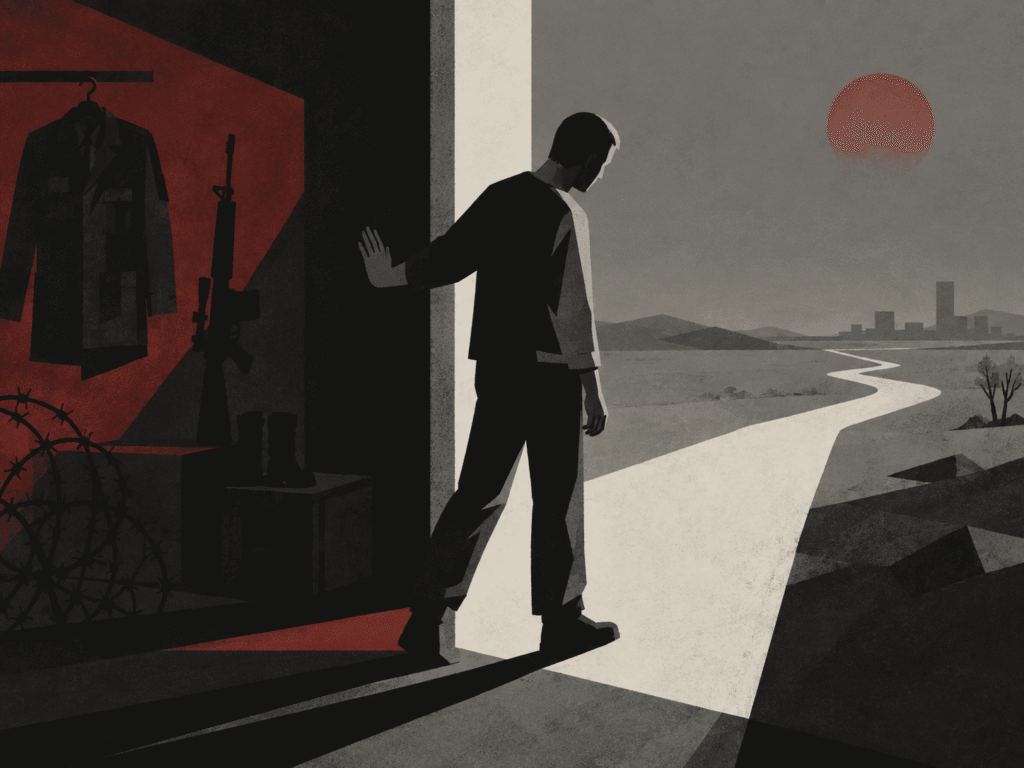
This is why I increasingly think of conscientious objection not as an endpoint, but as a threshold. A person says “no” to participation in war. That is necessary. But then a much longer path begins: from refusing to kill to the ability to live outside a culture of the enemy and to stop romanticising war; from individual rescue to social responsibility; from leaving the army to leaving war as a way of thinking and acting.
And perhaps this is where one of the central tasks of European antimilitarism and pacifism lies today. Not only to secure recognition of the right to conscientious objection for Belarusians, Russians and Ukrainians, regardless of how convenient their refusal is for our geopolitics, but also to begin seriously preparing for the demilitarisation of people and societies after the war. Because if we limit ourselves to removing a person from the front, or preventing them from reaching it, while leaving the logic of war itself untouched, the next war will begin long before the first shot is fired again.
Olga Karach
Human rights defender and Director of VšĮ “Our House Centre for Human Rights and Relief” in Lithuania. Her work focuses on human rights, conscientious objection, peace work, civil society and transnational repression.
For Graswurzelrevolution
About The Author