Torture of Aliaksandra Pulinovich Has Stopped. Now She Must Be Freed
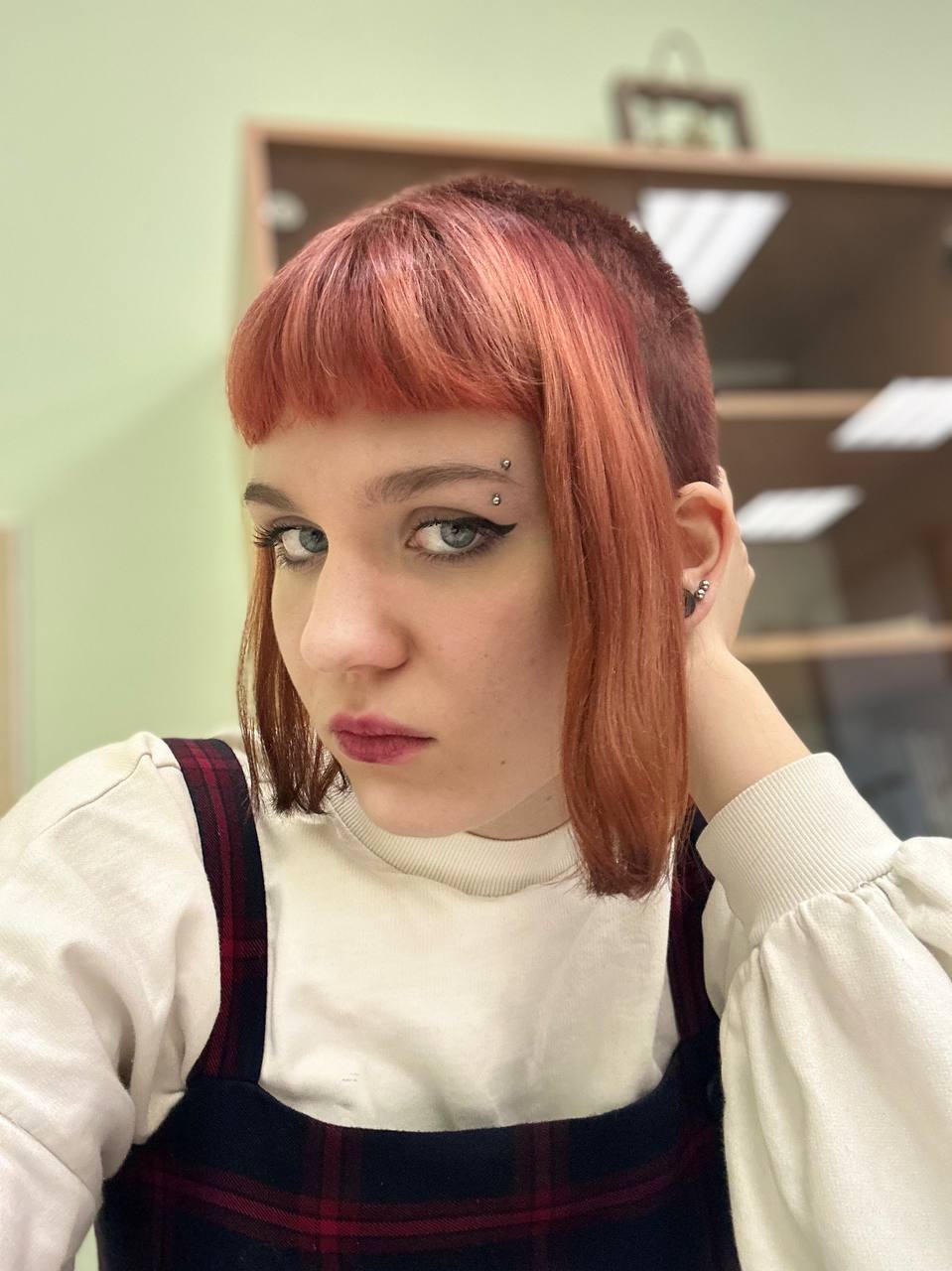
After international pressure, Aliaksandra Pulinovich’s treatment improved. But she remains imprisoned today.
Aliaksandra Pulinovich was only 16 when she was detained at her school on 12 January 2024. After a year-long investigation, she was sentenced to 10 years and three months in prison on charges including “high treason,” “terrorism,” and participation in an “extremist formation.” She is currently being held in Correctional Colony No. 4 in Homiel.
During her first ten days in detention, Aliaksandra was kept in the cold without bedding and had to cover herself with her own jacket. She spent almost the entire period before turning 18 in solitary confinement. There have also been reports of torture and severe ill-treatment of defendants in the same case, including beatings and guns being held to detainees’ heads during interrogations in an attempt to force confessions.
Who are the “Black Nightingales”?
Aliaksandra is one of a group of young anarchists known as the “Black Nightingales.” Most were minors when the case against them began. They held anti-war views and became the targets of an extraordinarily severe prosecution.
Belarusian state propaganda portrayed the young people as a dangerous “anarchist cell” allegedly linked to Ukrainian intelligence services and preparing acts of sabotage in Belarus and Russia. Yet the Belarusian authorities have not presented independently verifiable evidence substantiating this narrative, while publicly available information does not provide convincing evidence supporting accusations of such gravity.
State television played a central role in constructing the official narrative around the case. In the ONT propaganda film Children in the Crosshairs: Recruited by the Enemy, Aliaksandra Pulinovich, Maria Misiuk, Trafim Barysau, Siarhei Zhygaliou, Dzmitry Zakharoshka and Anastasia Klimenka were named and portrayed in a manner that effectively presented them as guilty before the judicial proceedings had been completed.
The sentences were exceptionally severe. Aliaksandra Pulinovich received 10 years and three months in prison; Dzmitry Zakharoshka received 10 and a half years; and Trafim Barysau and Siarhei Zhygaliou were each sentenced to 12 years. Maria Misiuk, who was also only 16 when detained, was sentenced to 13 years before being pardoned and released in November 2025.
For Our House Centre for Human Rights and Relief, the campaign for Aliaksandra became part of a broader effort, “Freedom for the Black Nightingales,” challenging the treatment of young peaceful anti-war activists as exceptionally dangerous terrorists.
For a long time, however, the case remained almost invisible outside Belarus. Closed proceedings and the label of “terrorism” made it extremely difficult to draw international attention to what was happening to these young people.
Our House therefore launched an international campaign. We collected testimony and evidence, prepared a detailed dossier documenting violations of Aliaksandra’s rights, approached UN human rights mechanisms, international human rights organisations, diplomats and politicians, conducted monitoring, launched a petition and an information campaign, and repeatedly raised her case internationally.
The objective was simple: Aliaksandra and the other Black Nightingales could no longer be allowed to disappear behind prison walls and outside international scrutiny.
From an almost invisible case to international attention
International partners, activists, journalists and supporters began recording videos, writing appeals, sharing information on social media and contacting diplomats and politicians. What started as an effort to draw attention to one teenager taken from her school gradually reached the United Nations, the European Parliament, international human rights organisations and diplomats in several countries.
US diplomats and officials working on the release of Belarusian political prisoners became involved. Our activists and supporters repeatedly raised Aliaksandra’s case with John Coale, US Special Envoy for Belarus, who subsequently made a public commitment to work for her release.
The United Nations and its independent human rights mechanisms also played a crucial role.
In June 2026, Nils Muižnieks, UN Special Rapporteur on the situation of human rights in Belarus, and other independent UN experts specifically raised Aliaksandra’s case. They noted that she had been only 16 when detained and addressed reports of ill-treatment during interrogation, prolonged solitary confinement and serious violations of her right to a fair trial.
The intervention also involved the UN Working Group on Arbitrary Detention; Ben Saul, Special Rapporteur on the promotion and protection of human rights and fundamental freedoms while countering terrorism; Gina Romero, Special Rapporteur on the rights to freedom of peaceful assembly and of association; the Working Group on Enforced or Involuntary Disappearances; the Working Group on discrimination against women and girls; and Alice Jill Edwards, Special Rapporteur on torture and other cruel, inhuman or degrading treatment or punishment.
This international engagement went beyond public statements: UN experts formally raised Aliaksandra Pulinovich’s case with the Belarusian authorities.
The European Parliament Demands Her Release
Another major turning point came on 18 June 2026, when the European Parliament explicitly named Aliaksandra Pulinovich in a resolution and called for her immediate and unconditional release. The resolution was adopted by an overwhelming majority: 504 Members of the European Parliament voted in favour and only four against.
MEP Petras Gražulis became personally involved in the campaign for Aliaksandra and continues to press for her release. For us, this is particularly important: his involvement did not end with a vote in the European Parliament. As long as Aliaksandra remains behind bars, the work continues.
The campaign has also received important support from IGFM — Internationale Gesellschaft für Menschenrechte, which helped raise the case and mobilise international solidarity. The German publication Graswurzelrevolution and the Swedish magazine Ställ om! helped ensure that the story of Aliaksandra and the Black Nightingales did not disappear into silence.
Journalists, human rights defenders, diplomats, politicians, international organisations and individuals in different countries wrote letters, shared information, recorded videos and published stories. Again and again, they repeated the same demand: Aliaksandra must be free.
Now We Have Important News
According to information we are currently receiving from Belarus, the torture and severe ill-treatment of Aliaksandra have stopped. Her conditions of detention have significantly improved, and she is now receiving adequate food.
We are also receiving information suggesting that the Belarusian authorities may be trying to improve her physical condition ahead of a possible release.
This information must be treated carefully. We want to distinguish clearly between previously documented facts and the new information now reaching us from Belarus. There is currently no official decision confirming Aliaksandra’s release. She remains behind bars.
For now, there is hope.
But the reported end of torture and the significant improvement in her conditions of detention are already an enormously important development.
Several months ago, UN experts raised concerns about the treatment of political prisoners in Belarus, including allegations of cruel, inhuman or degrading treatment and, in some cases, torture.
International pressure therefore has a very concrete human dimension. Behind prison walls, it can change what happens to an individual human being.
What International Pressure Can Actually Achieve
The impact of international action is not always measured in resolutions, statements or diplomatic declarations.
Sometimes its impact is a child who is no longer being beaten in a Belarusian prison. A young woman who is finally given proper food. A political prisoner who knows that she has not been forgotten and that people are still fighting for her freedom.
That is what collective international pressure can mean.
Every letter helped keep Aliaksandra’s case alive. Every parliamentarian, diplomat and UN expert who asked questions about her made it more difficult for her case to disappear into bureaucratic files. Every article broke through the information blockade. Every video, appeal, post and repost made it harder to hide Aliaksandra from international scrutiny.
But Aliaksandra Is Not Free Yet
That is why the campaign cannot stop now.
Its goal remains exactly what it was from the beginning: the immediate and unconditional release of Aliaksandra Pulinovich.
She was only 16 when she was taken from her school. A child with anti-war views who engages in peaceful protest should not be treated as an “especially dangerous terrorist.” Children must not be tortured. Children must not spend years in prison because of their beliefs.
We have already succeeded in bringing Aliaksandra’s name before the United Nations and the European Parliament. Her case is now being discussed by international human rights experts, politicians and diplomats.
Now that international attention must lead to the result that matters most: an open prison door.
There is one final step left: freedom.
Freedom for Aliaksandra Pulinovich.
Freedom for the Black Nightingales.
Freedom for children imprisoned in Belarus for political reasons.
Our detailed dossier documenting Aliaksandra Pulinovich’s case and the violations of her rights is available here:
https://ndbelarus.com/2026/04/16/aliaksandra-pulinovich-human-rights-violation-dossier/
About The Author