States that champion human rights defenders must consider candidacy for ECOSOC NGO Committee: UN experts
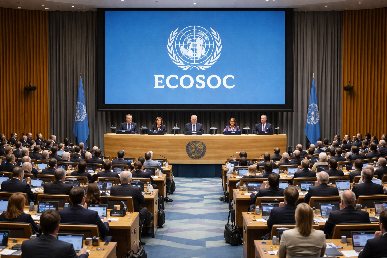
GENEVA (1 April 2026) – Independent human rights expert today urged Member States which are committed to prioritising human rights defenders and civil society space to stand in the upcoming elections for the Committee of Non-Governmental Organisations (the «NGO Committee»), a body of the UN Economic and Social Council (ECOSOC). Ahead of the April elections, they issued the following statement:
«We are increasingly concerned by attempts of a number of States to shut civil society out of UN spaces. Some States members of the NGO Committee abuse the accreditation process by repetitive deferral of applications for ECOSOC Consultative status in successive sessions thereby prolonging the application process, sometimes for years on end. This practice affects disproportionately many organizations working on the defense of human rights. At the same time, some States have actively promoted the accreditation of government-organised non-governmental organisations, which crowd out authentic civil society voices and distort the Committee’s deliberations.
We are very disappointed to see so few champions of human rights defenders and civil society putting forward their candidacy in these elections. Civil society is struggling to maintain some level of access and influence at the UN and the NGO Committee is the axis on which these hinge. Yet, the majority of States seeking election actively repress human rights defenders in their own countries.
The NGO Committee plays a key role in facilitating or denying access to civil society. Unfortunately in recent years, we have seen a trend of delaying and blocking accreditation of groups seeking to engage with the UN.
The NGO Committee is composed of 19 Member States which are elected once every four years by ECOSOC. All regional groups are represented. The Committee is tasked with considering the applications of non-governmental organisations for «ECOSOC consultative status», which allows NGOs to engage with the UN by accessing UN premises during sessions, participating in events, organising side-events and intervening at meetings.
The Member States which have announced their candidacy for the April 2026 elections are Asian Pacific States: China, India, Saudi Arabia, the UAE (for four seats); Eastern European States: Belarus, Estonia, and Ukraine (for two seats); Latin American and Caribbean States: Cuba, Nicaragua, and Peru (for four seats); African States: Cameroon, Côte d’Ivoire, South Africa, Sudan, Tunisia (for five seats); and Western European and Other States: Israel, Türkiye, the UK, and the US (for four seats).
We encourage Member States that do prioritise civil society voices to step up and contest the elections, and in doing so, give more opportunity to independent civil society to be heard in UN spaces and contribute to the work of the United Nations. We also call on States to change the procedure of the NGO Committee to allow for easier and quicker processing of accreditation requests from civil society, for example by ensuring that Committee members put in place a public comment period and send questions intersessionally, so that responses can be received for decisions to be taken timely each session. In the long-run, we encourage States to periodically review membership on this body benchmarked against their ratification of human rights treaties, universal periodic review performance and other indices of cooperation with the human rights system.
The UN Secretary-General has consistently warned that continued deferral of applications for ECOSOC consultative status has amounted, in some instances, to de facto rejection, especially for organisations working on politically sensitive human rights issues. This practice can constitute an obstacle to the engagement of civil society with the UN and effectively mute certain NGOs in UN spaces.
When questions are posed, a procedural deferral is triggered, whereby the Committee defers applications to its next session—usually six months later—to await the NGO’s written responses as outlined in official procedures. Such questions may relate to finances, activities, including advocacy at the UN, or governance. They are often repetitive, suggesting they form part of a strategy to block organisations, particularly those focusing on human rights, from gaining ECOSOC status.
According to a recent analysis, three states asked nearly 50 per cent of the
647 questions posed to NGO applicants during its first regular session in 2026.
We note that among those seeking a seat are States that have received a high number of complaints and communications from the Special Rapporteur on the situation of human rights defenders in the past years, which prompts concerns about these States’ ability and willingness to support civil society participation. We are alarmed to see so few champions of human rights defenders and civil society putting forward their candidacy in these election».
The experts:
Mary Lawlor, Special Rapporteur on the situation of human rights defenders
- Gehad Madi, Special Rapporteur on the human rights of migrants
- Margaret Satterthwaite, Special Rapporteur on the independence of judges and lawyers
- Gina Romero, Special Rapporteur on the rights to freedom of peaceful assembly and of association
- Ben Saul, Special Rapporteur on the promotion and protection of human rights and fundamental freedoms while countering terrorism
- Olivier De Schutter, Special Rapporteur on extreme poverty and human rights | OHCHR
- Tlaleng Mofokeng, Special Rapporteur on the right of everyone to the enjoyment of the highest attainable standard of physical and mental health
- Mai Sato, Special Rapporteur on the situation of human rights in the Islamic Republic of Iran
- Richard Bennett, Special Rapporteur on the situation of human rights in Afghanistan
- Nils Muižnieks, Special Rapporteur on the situation of human rights in Belarus
- Mariana Katzarova, Special Rapporteur on the situation of human rights in the Russian Federation
- Margaret Satterthwaite, Special Rapporteur on the independence of judges and lawyers
- Siobhán Mullally, Special Rapporteur on trafficking in persons, especially women and children
- Cecilia M. Bailliet, Independent Expert on human rights and international solidarity
- Graeme Reid, Independent Expert on sexual orientation and gender identity
- Muluka-Anne Miti-Drummond, Independent Expert on the rights of persons with albinism
- Alexandra Xanthaki, Special Rapporteur in the field of cultural rights
- Farida Shaheed, Special Rapporteur on the right to education
- Marcos A. Orellana, Special Rapporteur on toxics and human rights
- Elisa Morgera, Special Rapporteur on the promotion and protection of human rights in the context of climate change
- Paula Gaviria Betancur, Special Rapporteur on the human rights of internally displaced persons
- Suriya Deva, Special Rapporteur on the right to development
- Albert K. Barume, Special Rapporteur on the rights of indigenous peoples
- Nicolas Levrat, Special Rapporteur on minority issues
- Gabriella Citroni (Chair-Rapporteur), Grażyna Baranowska (Vice-Chair), Aua Baldé, Ana Lorena Delgadillo Pérez, Mohammed Al-Obaidi, Working Group on Enforced or Involuntary Disappearances
- Ms. Ganna Yudkivska (Chair-Rapporteur), Mr. Matthew Gillett (Vice-Chair on Communications), Ms. Miriam Estrada Castillo (Vice-Chair on Follow-Up),
Mr. Mumba Malila, and Mr. Ethan Hee-Seok Shin, the Working Group on Arbitrary Detention.
Special Rapporteurs/Independent Experts/Working Groups are independent human rights experts appointed by the United Nations Human Rights Council. Together, these experts are referred to as the Special Procedures of the Human Rights Council. Special Procedures experts work on a voluntary basis; they are not UN staff and do not receive a salary for their work. While the UN Human Rights office acts as the secretariat for Special Procedures, the experts serve in their individual capacity and are independent from any government or organisation, including OHCHR and the UN. Any views or opinions presented are solely those of the author and do not necessarily represent those of the UN or OHCHR.
Country-specific observations and recommendations by the UN human rights mechanisms, including the special procedures, the treaty bodies and the Universal Periodic Review, can be found on the Universal Human Rights Index https://uhri.ohchr.org/en/.
About The Author