Institutional Militarization of School Education in Belarus, 2025

Schools function as structured environments for early loyalty formation and pre–conscription military socialization.
Within the school education system in Belarus, militarization acquires a systemic and multi–level character. Unlike the preschool level, where the emphasis is placed on the symbolic presence of law–enforcement bodies, schools are used as a space for preparation for future military service, in which military themes gradually shift from rituals and narratives to practical forms of pre–conscription socialization.
The school environment allows the state to address several objectives simultaneously: to form loyalty, to normalize military service as a social obligation, and to reduce resistance to conscription even before conscription age is reached. To this end, a combination of mandatory educational formats, extracurricular activities, and direct contact between students and military infrastructure is employed.
Key Problematic Mechanisms
Firstly, schools entrench the mandatory nature of military and military–historical agendas as part of the educational process. Through centralized activities, military themes become not a subject of discussion or analysis, but a normative framework in which war and military service are presented as a natural and desirable form of civic realization. The absence of alternative interpretations excludes critical reflection and replaces the educational function with an ideological one.
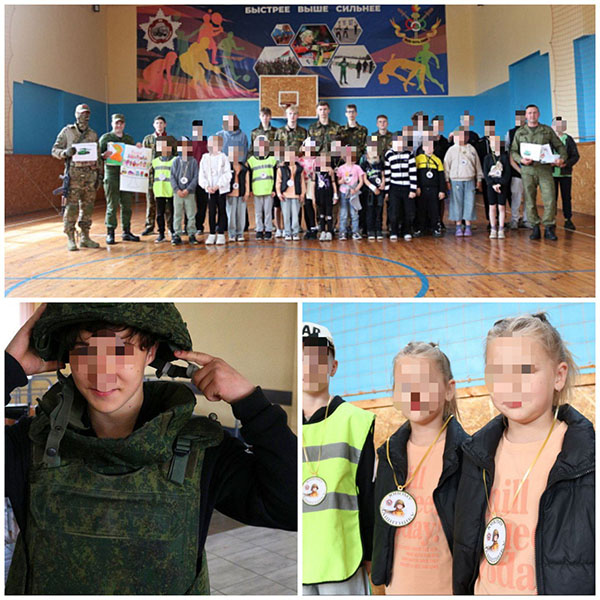
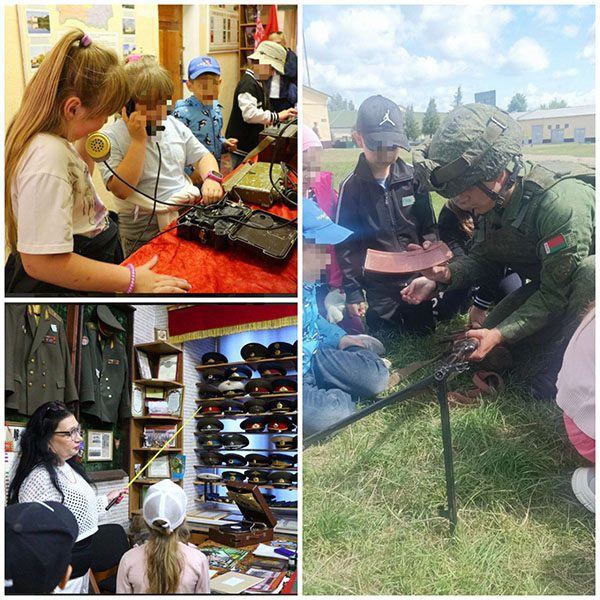
Secondly, there is a systematic blurring of the boundary between school and military infrastructure. Excursions to military units, visits to museums of military glory affiliated with active brigades, and demonstrations of weapons and equipment translate the army from an abstract institution into the direct experience of schoolchildren. The military environment is presented as an acceptable and safe space for children, while contact with weapons is framed as an element of «upbringing» and «education».
Thirdly, schoolchildren are deliberately involved in practices approximating initial military training. Day camps and round–the–clock residential camps, training in the disassembly and assembly of weapons, radio communications, and elements of military discipline form adolescents’ habitual adaptation to military routines and subordination long before formal conscription. These practices effectively perform the function of preliminary adaptation to military service, while formally remaining within the framework of «educational work».
Fourthly, school militarization is sustainable and reproducible in nature. The regularity of camps, their repetition over many years, the participation of active military units, and official coverage in departmental media indicate that these practices are not isolated initiatives, but an embedded element of state policy in the field of education.
Mandatory Centralized Activities
The National Educational Portal of the Republic of Belarus reported that on 7 May 2025, all educational institutions in the country were scheduled to conduct a «Lesson of Courage», dedicated to the 80th anniversary of Victory. The event was centralized and mandatory in nature and was used to transmit a unified state interpretation of history, based on military themes and the glorification of war.
Museum of Military Glory as an Extension of Military Infrastructure
On 30 June 2025, schoolchildren in the city of Slonim visited the Museum of Military Glory of the 11th Separate Mechanized Brigade, supplemented by an exhibition of weapons and military equipment.

About The Author