If the Bomb Never Explodes, That Does Not Mean It Leaves No Trace
Why the environmental cost of nuclear deterrence belongs in the security debate
There is a rather strange system of accounting in nuclear policy. We carefully count warheads and missiles, range and flight time, and the capacity to launch a retaliatory strike, yet we are far less likely to count the land, water and human lives already affected by the production and testing of these weapons. The result is a paradox: a nuclear bomb may never explode over a city and still leave a legacy that lasts for generations.
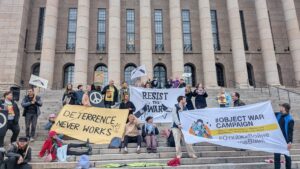
A recent Climate Desk Live discussion in New York brought this side of nuclear security into unusually sharp focus. One panel was titled “Nuclear Legacy: Mapping Local Impacts.” It brought together Lilly Adams, co-creator of the US Nuclear Impacts Map; Moñeka DeOro of the Micronesia Climate Change Alliance; and Leona Morgan, a Diné activist and organiser with Diné No Nukes. The discussion was moderated by Sharon Weinberger, editor-in-chief of the Bulletin of the Atomic Scientists. The framing itself mattered: nuclear legacy was discussed not as an abstract chapter of Cold War history, but alongside environmental justice, local communities, and the question of who gets to make decisions and who is left to live with their consequences.
The bomb begins leaving a trace long before it explodes
When we imagine the environmental consequences of nuclear weapons, our minds almost automatically go to the mushroom cloud. But the nuclear weapons life cycle begins much earlier: with uranium mining and processing, the production of fissile materials, reactor operations and chemical separation, component manufacturing, testing, arsenal maintenance, waste storage and, eventually, the cleanup of contaminated sites.
This is not merely a matter of historical record. The U.S. Department of Energy explicitly describes its mission today as addressing the environmental legacy of decades of nuclear weapons development and production. That legacy includes radioactive waste, spent nuclear fuel, surplus plutonium and uranium, thousands of contaminated facilities, and polluted soil and groundwater. In other words, part of the environmental cost of the nuclear age did not remain in Cold War history books. It is still in the ground.
In 2026, the U.S. Government Accountability Office estimated the Department of Energy’s remaining nuclear cleanup work at more than $640 billion, with decades of work still ahead. In another report, the GAO noted that cleaning up soil and legacy landfills at just eight sites it examined could cost roughly $15 billion and continue for another six decades. The figures show how artificial the distinction can become between the “cost of the weapon” and the cost of what its production leaves behind.
Deterrence produces waste too
In the theory of nuclear deterrence, the ultimate success is a weapon that exists but is never used. There is a terrible logic to this: the arsenal must be credible enough that no one ever has to fire it. Environmentally, however, the formula is incomplete. Even perfectly “successful” deterrence requires physical infrastructure, and physical infrastructure produces waste, contamination, and long-term obligations to store, monitor and clean them up.
This changes the question. Instead of asking only, “What happens if a nuclear weapon is used?”, we also have to ask, “What is already happening while it is not being used?” That is a much less comfortable question because it prevents us from assigning all harm to some hypothetical future nuclear conflict. Some damage has already occurred, some is being addressed now, and some obligations will pass to people who had no role in the decisions to build these arsenals.
The U.S. cleanup site at Moab, Utah, makes this legacy strikingly tangible. Uranium was processed there during the Cold War, and contaminated groundwater posed risks to the Colorado River. By 2026, more than 16 million tons of uranium mill tailings and other materials had been removed as part of the cleanup, while the project’s total cost was expected to reach roughly $1.16 billion. Here, nuclear history is no longer measured in warheads but in millions of tons of material that must be moved somewhere and safely isolated.
Who gets the security, and who gets the waste?
But perhaps the most important question is not technological at all. It is political: how is this cost distributed? Climate Desk Live deliberately placed its discussion of nuclear legacy in the context of impacts on Indigenous communities, communities of color and rural areas. That changes the perspective fundamentally. National security is framed as a collective good, while contamination always has an address.
It has a particular piece of land, a particular source of water and particular people living nearby. On Navajo/Diné lands, the legacy of uranium mining has for decades been associated with abandoned mines and contamination; environmental justice research has shown that the risks of the nuclear weapons complex have not been distributed equally, disproportionately affecting Indigenous, non-white, poor and rural communities. At another end of the American nuclear story are Pacific Island communities on whose lands, or nearby, nuclear tests were conducted.
This produces an uncomfortable arrangement: the benefits of deterrence are described as national, strategic and sometimes even global, while part of the environmental and health burden remains intensely local. Some receive “strategic stability”; others receive land that requires cleanup for decades. At that point, the nuclear weapons debate stops being only a debate about strategy and becomes a debate about justice.
The test ends. The radioactivity may not.
Scientific research on the consequences of nuclear testing has long shown that radioactive contamination travelled through the atmosphere, water and soil, and that its geography did not respect the boundaries of test sites. Radioactive isotopes entered the environment, while the consequences of some tests required years of monitoring and remediation.
This is another reason why the traditional language of security is too narrow. In that language, the state border matters enormously: who threatens whom, where forces are deployed, whose territory is being defended. Radioactive fallout, contaminated groundwater and long-lived waste are considerably less respectful of borders. The environmental legacy of military security can follow its own geography and its own calendar.
The strange accounting of security
If a company produces a product while creating enormous future liabilities for pollution cleanup, few economists would agree that those liabilities have nothing to do with the cost of production. In nuclear policy, however, we seem much more comfortable placing the bills in different agencies and different decades.
The cost of building and maintaining the arsenal goes in one column. Environmental cleanup goes in another. Health consequences in a third. Long-term waste management in a fourth. Harm to particular communities may be difficult to price at all. The first column is then solemnly described as the cost of national security, although a substantial part of the bill is simply sitting on the next desk.
None of this means that every discussion of nuclear deterrence must immediately end with one predetermined political conclusion. States that rely on nuclear weapons make serious arguments about military threats, deterrence and the prevention of major war. That is precisely why the analysis must be serious and complete. If we call something a security system, we should account not only for the threat it is intended to prevent, but also for the risks the system itself creates.
Security for whom?
In my previous article on the language of security, I asked a simple question: when we speak of human security, whose security are we actually measuring? The environmental legacy of nuclear weapons makes that question almost physically tangible.
State security and human security can coincide, but they do not do so automatically. Strategic stability between major powers and the safety of a community living beside a contaminated site are different scales of the same political decision. If the first appears constantly in strategy papers and negotiations while the second appears only in environmental cleanup documents, then the problem is not only contamination. It is also how we define security itself.
The voices of communities that have long been located not at the decision-making table but beside mines, test sites, production facilities and waste repositories therefore matter enormously. Their expertise is not lesser simply because it begins not with deterrence doctrine but with water, land, family health and the memory of a particular place.
Environmental security is not an appendix to “real” security
We are accustomed to dividing issues into the serious and the supplementary. Nuclear strategy is treated as “hard security,” while the environment often arrives later—as a consequence, a humanitarian dimension or the subject of a separate panel. Yet when those consequences last for decades, require hundreds of billions of dollars, and affect whether land and water can be used safely, it becomes difficult to explain why they sit outside the core definition of security.
Perhaps we need more honest language. Not “nuclear weapons provide security but have environmental consequences,” but rather: “nuclear policy simultaneously creates certain forms of security and certain forms of risk, and those risks are distributed unevenly among people, places and generations.” It is a less convenient formulation, but a much more accurate one.
The bill for future generations
There is another dimension that fits awkwardly into ordinary political debate: time. A government makes a decision today, and military strategy is planned for the coming years or decades, while some forms of radioactive legacy require management far beyond the political career of anyone who made the original decision.
It becomes a kind of security loan: the present generation receives the strategic benefit now, while passing part of the cost of waste management, monitoring and cleanup to people who do not yet vote, pay taxes or perhaps even exist. They did not sign the agreement, but the repayment schedule is already in place.
The full cost of peace
That is why the environmental footprint of nuclear weapons belongs not at the edge of the security debate but at its centre. This is not an attempt to replace the discussion of nuclear risk with an environmental one. It is an attempt to make our understanding of security more complete.
If we calculate the cost of nuclear deterrence, we should count not only warheads and delivery systems, but also material production, waste, contaminated land, cleanup, long-term storage and the consequences for communities. If we speak about benefits to the state, we should ask at the same time who receives the risks. And if we speak about protecting future generations from war, we should include in the calculation the legacy those generations will inherit even if nuclear war never happens.
Perhaps this is the central paradox of nuclear weapons. We are accustomed to judging their success by an event that did not happen: the bomb was not used. But the absence of an explosion does not mean the absence of consequences.
The bomb may never fall.
Its trace may already be in the ground.
Sources and further reading
1. Climate Desk Live, “AI, Energy, and Our Fight for Democracy and a Healthy, Affordable Future,” The New School / Climate Week NYC, 24 September 2026.
2. U.S. Government Accountability Office, “Nuclear Waste Cleanup: DOE Is Missing Opportunities to Apply Lessons from Other Countries That Could Reduce Risks and Costs,” GAO-26-108082, 29 July 2026.
3. U.S. Government Accountability Office, “Nuclear Waste Cleanup: DOE Should Collect Information Specific to Soil and Legacy Landfills to Inform Overall Remediation Efforts,” GAO-25-107565, 26 September 2025.
4. U.S. Government Accountability Office, “Nuclear Waste: DOE’s Plans to Complete Cleanup and Transfer of Moab Mill Site,” GAO-26-108654, 15 July 2026.
5. U.S. Department of Energy, Office of Environmental Management, overview of the environmental legacy of nuclear weapons development and production.
6. Remus Prăvălie, “Nuclear Weapons Tests and Environmental Consequences: A Global Perspective,” Ambio 43 (2014): 729–744.
7. Steve Wing, “Ethics for Environmental Health Research: The Case of the U.S. Nuclear Weapons Industry,” New Solutions 20(2) (2010).
8. Union of Concerned Scientists, “Nuclear Frontline Communities,” updated 3 March 2026.
Image credits
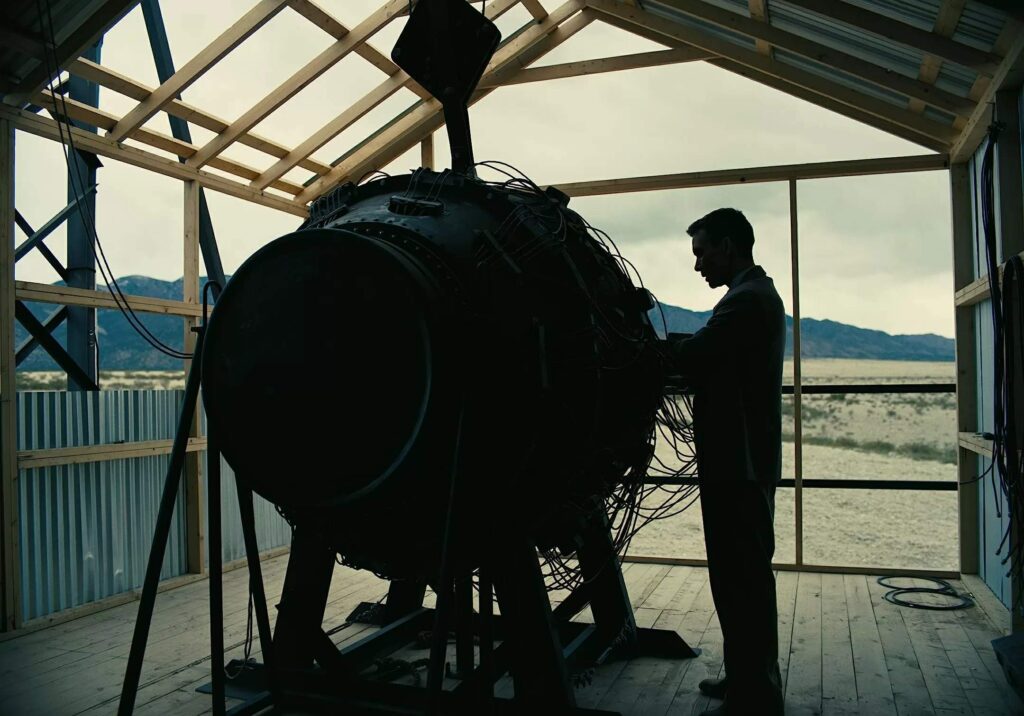
Opening image: Still from Oppenheimer (Christopher Nolan, 2023), Universal Pictures.
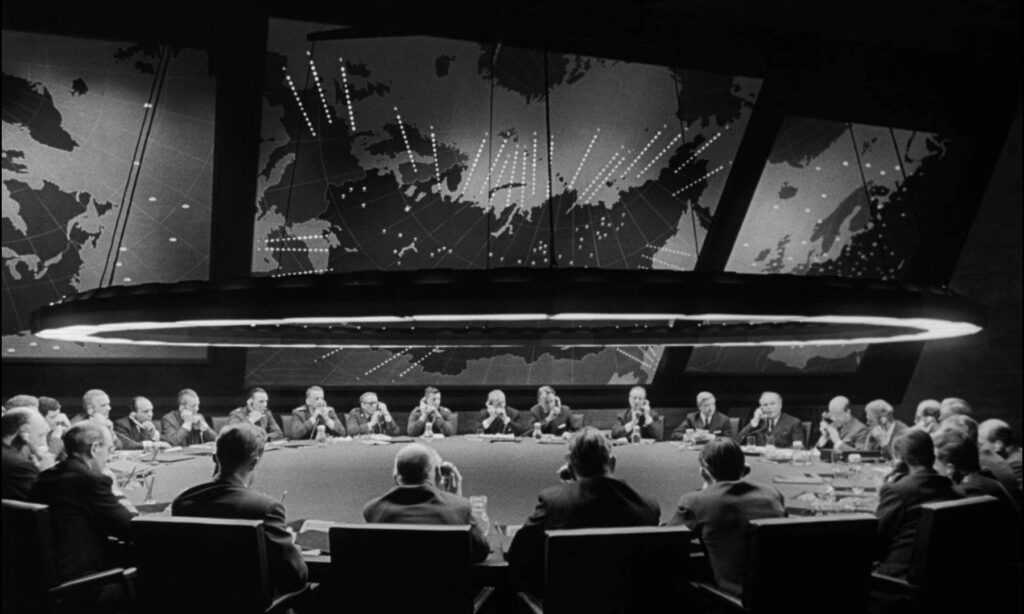
In-text image: Still from Dr. Strangelove or: How I Learned to Stop Worrying and Love the Bomb (Stanley Kubrick, 1964), Columbia Pictures
About The Author