Annual Report Systemic Human Rights Violations in Belarus Denial of the Right to Conscientious Objection and Forced Military Service

How military logic in Belarus becomes a social norm from early childhood, displacing the right to refuse service.
Submitted by “Our House”
2025
This report examines how, in 2025, militarization in Belarus has taken shape as a continuous system of state coercion that accompanies individuals throughout their lives. It traces how kindergartens, schools, military-patriotic clubs, camps, and state media are used to normalize the army as the only acceptable form of “civic maturity.” The reader is guided through the shift from symbolic “patriotic education” to concrete practices of pre-conscription training, followed by legal and administrative pressure on conscripts, reservists, and conscientious objectors. Visual materials drawn from official sources illustrate not isolated abuses, but a stable model in which upbringing, ideology, and coercion merge into a single, integrated system.
Executive Summary
In 2025 in Belarus, militarization ceases to be a separate policy direction and manifests as a cross-cutting system that encompasses a person throughout their entire life. It begins in early childhood—through kindergartens and schools—continues in adolescence through military-patriotic clubs, camps, and elements of pre-conscription training, intensifies during the conscription period through public propaganda of military service, and persists after its formal completion through the reserve system.
An analysis of verified facts for 2025 shows that the state consistently uses educational, cultural, and leisure infrastructure to normalize military logic, shaping the perception of military service as an inevitable and the only acceptable form of civic behavior. Under these conditions, the right to conscientious objection to military service is substantially restricted, while alternative service is inaccessible for most individuals with non-religious beliefs.
Taken together, the identified practices indicate that in Belarus there is no clear boundary between upbringing, ideology, and coercion: militarization does not end with the completion of school or service, but transforms into various forms of administrative and legal control, including long-term reserve obligations. This report documents these processes on the basis of facts from 2025 and demonstrates their systemic, rather than episodic, nature.
All visual materials included in the report were obtained from open official sources (state websites, departmental publications, official Telegram channels, and media resources), links to which are provided in the footnotes. The faces of minors in images have been anonymized in order to protect the right to privacy. The publication of images pursues an exclusively documentary and analytical purpose.
Militarization of preschool-aged children (3-6 years)
Militarization begins already at the kindergarten level: children aged 3–6 are regularly exposed to military symbols and narratives, as well as to the direct presence of representatives of law-enforcement and military bodies. Formally, these practices are framed as “patriotic education,” but in substance they function as early military socialization—through the authority of the uniform, rituals, “approved” narratives, and the integration of military infrastructure into children’s everyday life.
At the level of practical implementation in preschool institutions, the same mechanisms are repeatedly observed:
external supervision by military and law-enforcement bodies (visits, joint events, participation in “educational” formats);
ritualized forms of “patriotism” (children’s public performances, symbols, “lessons,” ceremonies);
normalization of the military environment as a space for children (including organized visits to military facilities or the direct participation of military personnel in kindergarten events);
public replication through departmental media (photo galleries and reports in which children serve as a “showcase” of correct upbringing).
Slavgorod (14 March 2025).1 In Kindergarten No. 2, an event titled “A Letter about Belarus” was held with the participation of the Prosecutor’s Office: a representative of the Prosecutor’s Office addresses preschool children with theses about the agency’s role in ensuring “order/safety,” despite violations of the principles of legality and human-rights protection in Belarus documented in international human-rights mechanisms.
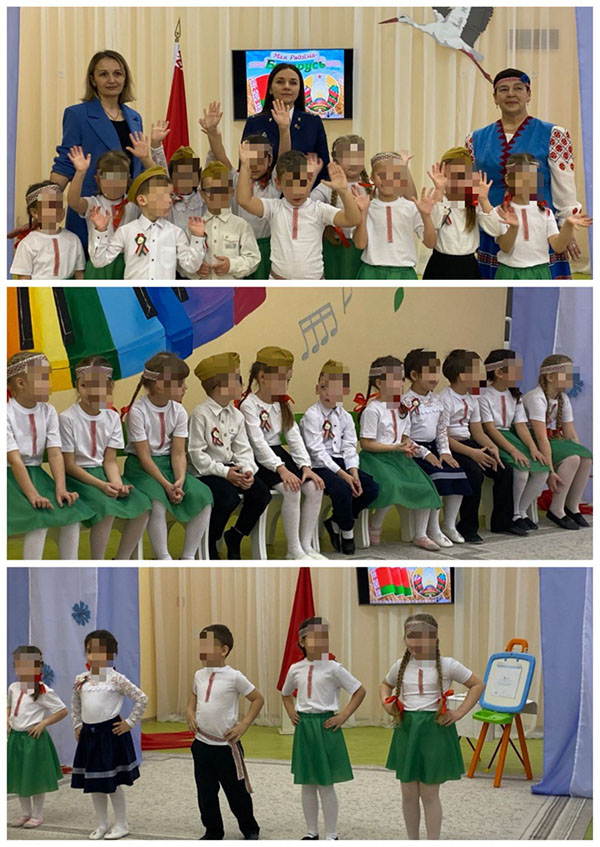
Fanipol (26 June 2025).2 In Kindergarten No. 2, a “patriotic” event took place as part of the campaign “Belarus Peaceful! Belarus Beautiful!” with the participation of servicemen from the 15th Anti-Aircraft Missile Brigade. They were presented to preschool-age children as acceptable and desirable participants in the educational space.
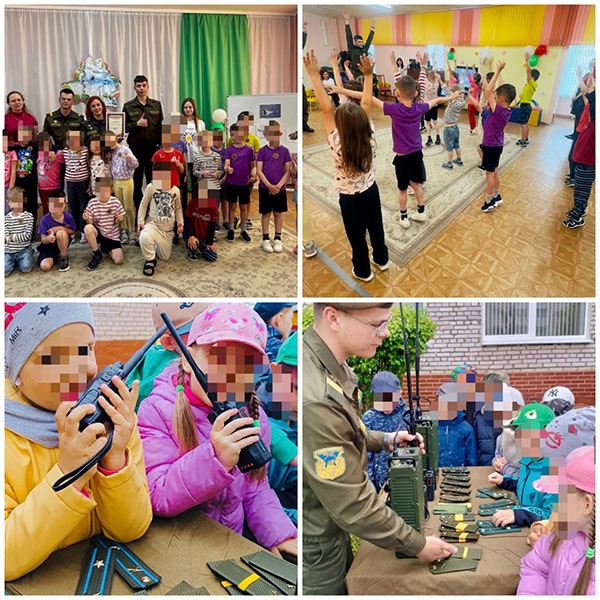
Brest (2025).3 Officially, it was reported that the practice of organized group visits to the 38th Brest Separate Guards Air Assault Brigade continues; among such groups, pupils of preschool institutions were specifically mentioned. The format included excursions, demonstration training sessions, and sports activities on the territory of a military facility.
Thus, the embedded nature of these practices is ensured not by “isolated initiatives,” but by an institutional model: interaction between educational institutions and military/law-enforcement bodies is formalized through stable partnerships and regular activities, while “patriotic education” is used as a channel for introducing the military agenda into early education. This creates a situation in which a child’s contact with military symbolism and the authority of law-enforcement bodies begins at the kindergarten level.
Militarization in the School Education System
Within the school education system in Belarus, militarization acquires a systemic and multi-level character. Unlike the preschool level, where the emphasis is placed on the symbolic presence of law-enforcement bodies, schools are used as a space for preparation for future military service, in which military themes gradually shift from rituals and narratives to practical forms of pre-conscription socialization.
The school environment allows the state to address several objectives simultaneously: to form loyalty, to normalize military service as a social obligation, and to reduce resistance to conscription even before conscription age is reached. To this end, a combination of mandatory educational formats, extracurricular activities, and direct contact between students and military infrastructure is employed.
Key Problematic Mechanisms
Firstly, schools entrench the mandatory nature of military and military-historical agendas as part of the educational process. Through centralized activities, military themes become not a subject of discussion or analysis, but a normative framework in which war and military service are presented as a natural and desirable form of civic realization. The absence of alternative interpretations excludes critical reflection and replaces the educational function with an ideological one.
Secondly, there is a systematic blurring of the boundary between school and military infrastructure. Excursions to military units, visits to museums of military glory affiliated with active brigades, and demonstrations of weapons and equipment translate the army from an abstract institution into the direct experience of schoolchildren. The military environment is presented as an acceptable and safe space for children, while contact with weapons is framed as an element of “upbringing” and “education.”
Thirdly, schoolchildren are deliberately involved in practices approximating initial military training. Day camps and round-the-clock residential camps, training in the disassembly and assembly of weapons, radio communications, and elements of military discipline form adolescents’ habitual adaptation to military routines and subordination long before formal conscription. These practices effectively perform the function of preliminary adaptation to military service, while formally remaining within the framework of “educational work.”
Fourthly, school militarization is sustainable and reproducible in nature. The regularity of camps, their repetition over many years, the participation of active military units, and official coverage in departmental media indicate that these practices are not isolated initiatives, but an embedded element of state policy in the field of education.
Mandatory Centralized Activities
The National Educational Portal of the Republic of Belarus reported that on 7 May 2025, all educational institutions in the country were scheduled to conduct a “Lesson of Courage”,4 dedicated to the 80th anniversary of Victory. The event was centralized and mandatory in nature and was used to transmit a unified state interpretation of history, based on military themes and the glorification of war.5
Museum of Military Glory as an Extension of Military Infrastructure
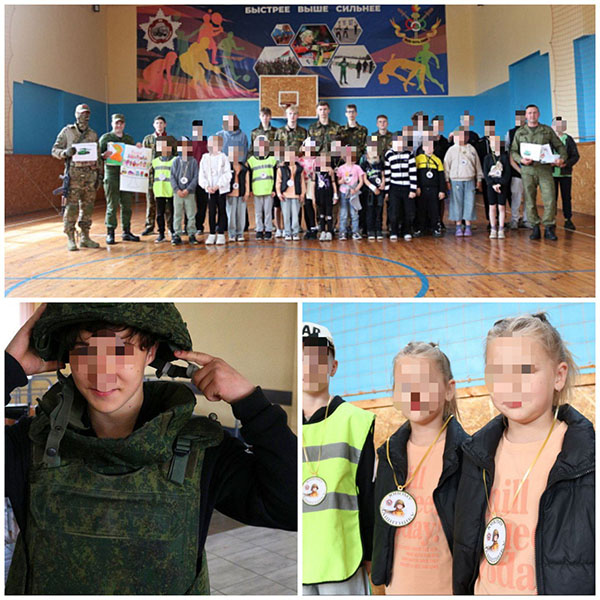
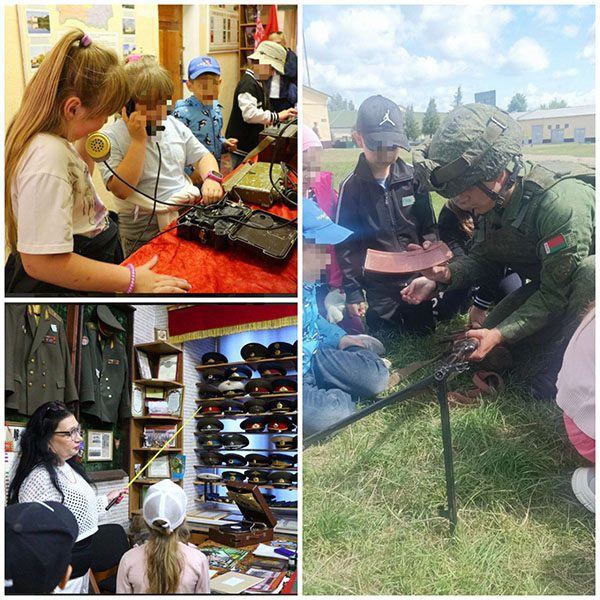
On 30 June 2025, schoolchildren in the city of Slonim visited the Museum of Military Glory of the 11th Separate Mechanized Brigade, supplemented by an exhibition of weapons and military equipment.6
Military-Patriotic Camps with Elements of Training
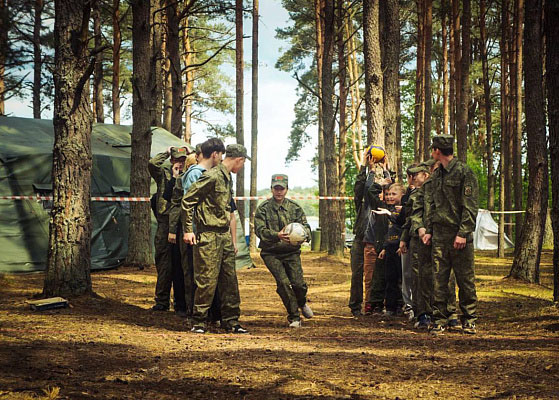
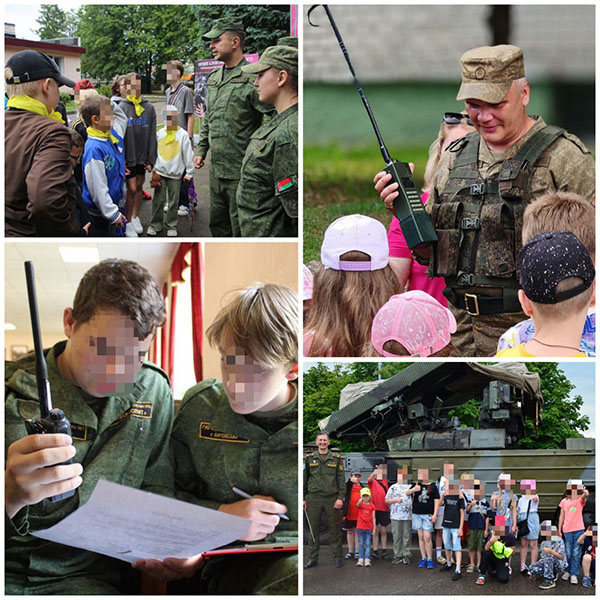
On 12 July 2025, it was reported that day camps and round-the-clock residential camps were operating in which servicemen conducted training sessions on the disassembly and assembly of assault rifles, radio communications, and fitting of military equipment.7
Prolonged Stay of Schoolchildren on the Premises of Military Units
On 22 July 2025, a third summer session of a round-the-clock residential camp was documented on the premises of the 83rd Engineering and Airfield Regiment; the report emphasized the long-term regularity of this practice (“13th consecutive year”) and the large-scale involvement of children.8
 Military-Patriotic Clubs and Pre-Conscription Training
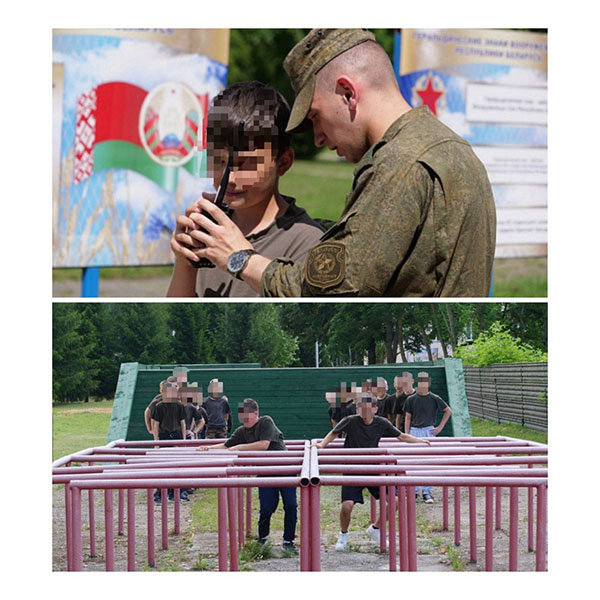
Military-patriotic clubs in Belarus constitute a key connecting element between school education and subsequent forms of military coercion. Unlike one-time events or camps, clubs create a long-term, institutionally embedded environment in which adolescents are consistently and progressively involved in military and military-ideological logic over the course of several years.
Through the club system, the state simultaneously addresses several objectives: it forms sustained loyalty to the armed forces, accustoms adolescents to military discipline and hierarchy, and reduces the likelihood of refusal of military service by replacing the right to choice with a pre-constructed trajectory of “normal” growing up. Participation in clubs is presented as voluntary and prestigious; however, in practice it becomes a continuation of mandatory school-based “patriotic education” in a more rigid and targeted form.
Problematic Mechanisms
Firstly, military-patriotic clubs are institutionally linked to active military and law-enforcement bodies, rather than to civilian educational or sports organizations. Clubs are established on the basis of military units and subdivisions of the Ministry of Defence and the Ministry of Internal Affairs, which means that their activities are directly dependent on departmental ideology and objectives.
Secondly, clubs function as a space for early pre-conscription training, where adolescents are introduced not only to symbolism and history, but also to practical elements of military service: drill discipline, tactical training, elements of weapons handling, obedience to orders, and acceptance of hierarchy as a norm. These practices cultivate habituation to military logic long before conscription age.
Thirdly, the club system lacks an alternative framework. Participation does not involve discussion of the right to refuse military service, civilian forms of service to society, or non-militarized models of patriotism. On the contrary, military service and readiness for it are established as the only acceptable form of “responsible civic behavior.”
Fourthly, clubs perform the function of a personnel reserve: they are embedded in a vertical structure that logically continues through camps, training assemblies, reserve service, and subsequent conscription. As a result, participation in a club becomes part of a continuous process, from which it becomes increasingly difficult for an adolescent to exit without conflict with the system.
Club based at a military unit (Zhodino)
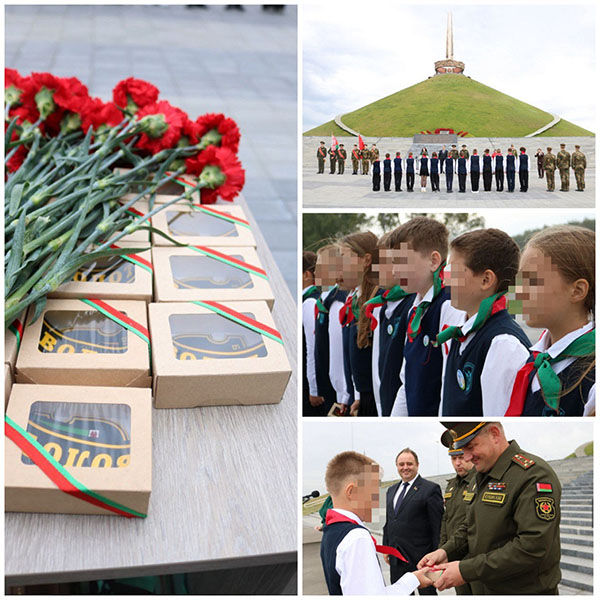
On 16 September 2025, students of Gymnasium No. 1 in the city of Zhodino took part in a ceremonial induction into the military-patriotic club “Volot”, established on the basis of the 65th Automobile Brigade. The event was held in a ritualized format with the participation of a representative of the Ministry of Defence responsible for ideological work. The format itself emphasizes the institutional link between the club and an active military unit, as well as the use of military symbolism and ceremonial practices in the involvement of minors.9
Network of clubs under the auspices of the Ministry of Internal Affairs.
In 2025, the Ministry of Internal Affairs officially reported that more than 200 military-patriotic clubs operate under the auspices of internal affairs bodies and the internal troops of the Ministry of Internal Affairs, involving over six thousand children and adolescents. Thus, the militarization of the adolescent environment is carried out not only through the Ministry of Defence, but also through a law-enforcement body with repressive functions, which expands the scope and institutional density of this system.10 11
Normative formalization of the club system.
In 2025, the activities of military-patriotic clubs received direct normative formalization within the system of the Ministry of Defence. Orders and programmatic documents were published on the official portal of the Ministry of Defence, including Order of the Minister of Defence No. 1221 of 25 August 2025,12 as well as the “Programs of the Military-Patriotic Club of the Armed Forces of the Republic of Belarus.” In the explanatory materials, the purpose of the clubs is defined as fostering “loyalty to the Motherland” and readiness to carry out tasks to defend the Fatherland, with the target group identified as minors aged 15-17.13
Link to subsequent forms of coercion
Thus, military-patriotic clubs function not as an optional form of leisure activity, but as a structural element of the pre-conscription system. They create a transition from school militarization to more rigid formats—camps, training assemblies, and reserve service—forming a situation in which refusal to participate in the military system becomes socially and psychologically difficult even before conscription age is reached.
Public propaganda of military service and the crisis of the conscription model
By 2025, state policy in the field of conscription in Belarus is increasingly accompanied by aggressive and intrusive public propaganda of military service. The intensification of such campaigns by senior officials and law-enforcement bodies indicates a systemic crisis of the conscription model, in which military service is no longer perceived by young people as socially desirable or self-evident.
It is indicative that the need to “increase the attractiveness of military service” is regularly articulated at the highest level. Public statements emphasize problems of conscript motivation, young people’s unwillingness to undergo compulsory military service, and the need to “work with the consciousness” of future conscripts. The very presence of such rhetoric demonstrates that the coercive nature of conscription increasingly requires ideological and media-based compensation.
Problematic mechanisms of propaganda
Firstly, the state employs mass media campaigns aimed at creating a positive and “fashionable” image of the army. Military service is presented through entertainment and pop-cultural formats, which sharply contrasts with the real conditions of compulsory service and underscores the artificial nature of the constructed image.
Secondly, propaganda deliberately blurs the boundary between voluntary choice and obligation. The army is portrayed as a space for self-realization, a “school of life,” and a social elevator, while risks, restrictions of rights, the impossibility of refusal, and consequences for the health and mental condition of servicemen are silenced.
Thirdly, the public campaign relies on visual and emotional pressure, rather than informed choice. The use of images of “success,” “masculinity,” and “heroism” substitutes for discussion of the actual rights of conscripts and alternative forms of service, which are largely absent from official discourse.
Fourthly, propaganda of military service is closely linked to the previously described militarization of children and adolescents. In conditions where the army ceases to be attractive to young adults, the state shifts its focus to younger age groups, forming loyalty and habituation to military logic long before conscription age.
Public statements on the need to “increase the attractiveness of the army”
In 2025, representatives of state bodies, including the highest political leadership and the Ministry of Defence, through their public actions demonstrated the need to intensify efforts to form a positive attitude toward compulsory military service, which in fact constitutes an acknowledgement of its declining public attractiveness.14 15 16 The state operates under conditions of personnel shortages and increases conscription activity through administrative measures and propaganda.
Media campaigns of the Ministry of Defence
In 2025, the Ministry of Defence disseminated video materials and visual advertising aimed at promoting an image of military service as prestigious and desirable. The campaigns actively used elements of show culture and entertainment aesthetics, contrasting with demonstrably depersonalized images of soldiers, which underscores the propagandistic nature of these materials.
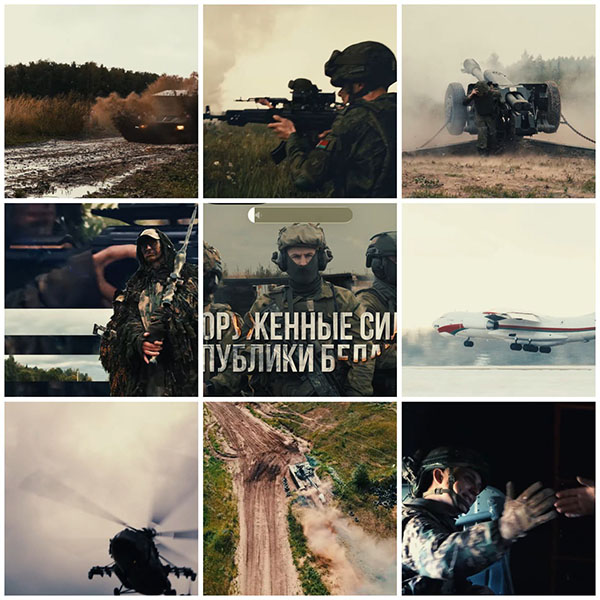 Video materials of the Ministry of Defence of Belarus disseminated in 2025 as part of campaigns promoting military service are constructed using cinematic aesthetics. They consistently depict scenes of firing automatic weapons, the operation of artillery, the movement of armored vehicles across rough terrain, flights of combat aircraft and helicopters, as well as close-up shots of fully equipped servicemen in combat conditions. The visual sequence emphasizes physical strength, armament, and combat readiness, while completely lacking any explanations regarding the legal status of servicemen, conditions of service, or the rights of conscripts.17
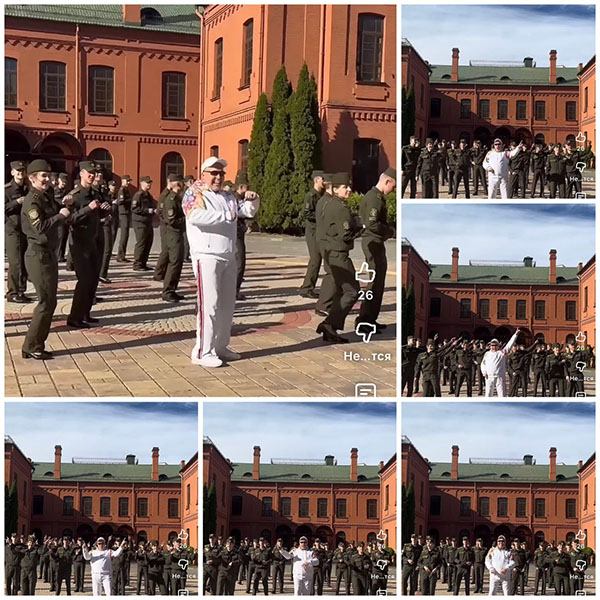 In another video used as part of the campaign to “increase the attractiveness of military service,” military themes are presented through an entertainment format involving a pop performer well known in Belarus. The performer, shown in a demonstratively civilian image, interacts with a group of cadets, while choreography and mass movement serve as the main visual device. The soldiers appear as a depersonalized group, whereas the civilian artist occupies a dominant position in the composition, underscoring the symbolic and propagandistic nature of the material. 18
Promotion of military service through “patriotic” leisure and public events
Military service is promoted not only through direct advertising, but also through mass “patriotic” events, festivals, and campaigns addressed, among others, to adolescents and young people of pre-conscription age.19 20 These formats increase pressure on future conscripts by presenting military service as a social norm, and refusal as a deviation.
Tightening of the legal and regulatory framework of military obligation (changes in 2025)
In 2025, state policy in the field of military obligation was supplemented by significant amendments to criminal legislation aimed at strengthening liability for failure to comply with conscription-related and related obligations.
Strengthening liability for evasion of military obligation
On 17 February 2025, the President signed the Law “On Amendments to Codes on Issues of Criminal Liability.”21 Among other things, the amendments affected approaches to the application of provisions of the Criminal Code of the Republic of Belarus regulating liability for evasion of conscription measures and other obligations related to military service.
Official explanations indicated an increase in liability for failure to appear at military commissariats and an expansion of the grounds for bringing criminal charges for violations that had previously been considered less serious. These changes effectively reduce the space for formal or de facto evasion of conscription measures and strengthen the punitive nature of the system of military obligation.22 23
In October 2025, a fundamentally new logic governing the interaction between criminal prosecution and conscription procedures was established. In accordance with the amendments reflected in Law No. 101-Z, as well as in official explanations by state media, a person against whom criminal proceedings have been initiated under Article 435 of the Criminal Code may be released from criminal liability on the condition of submitting a written statement of readiness to fulfill military obligation, after which the person is subject to conscription for service.24
This legal construction forms a mechanism of coercive “choice without choice,” in which criminal prosecution is used as an instrument of compulsion to military service, and consent to serve becomes a condition for the termination of criminal proceedings.
Restart of the military registration system and strengthening of administrative control
On 17 September 2025, Resolution of the Council of Ministers of the Republic of Belarus No. 505 “On Military Registration” was adopted, approving a new Regulation on military registration and repealing a number of previously existing subordinate normative acts.25
The Regulation defines the system of registration of persons liable for military service and conscripts as a state system that includes the registration of citizens at their place of residence, work, and study. These norms strengthen administrative control and fix citizens’ obligations with regard to military registration regardless of their actual place of residence, which means that citizens of Belarus residing outside the country who have not been removed from military registration in accordance with the established procedure continue to be considered liable for military service within the Belarusian system and may be subject to summonses or liability for failure to receive call-up notices.
The new regulation expanded the obligations of employers, educational institutions, and housing organizations to transmit data on citizens subject to military registration, and also strengthened control over changes in place of residence, employment, and actual living arrangements. Military commissariats received more stringent grounds for conducting inspections and requesting information.
In essence, this resolution created an administrative infrastructure of comprehensive military registration, increasing the effectiveness of coercion at all stages—from summonses to military commissariats to control over the movement of citizens.
Preservation and strengthening of the concept of the “trained soldier”
In parallel with the tightening of criminal liability in 2025, the immutability of the basic defence concept based on mass involvement of the population was reaffirmed at the highest political level. State sources quoted Lukashenko’s position that “drones are a new reality, but no drone will replace a trained soldier.” In the same context, the need to expand forms of citizen participation in defence was emphasized, including the development of territorial and other forms of mobilization readiness.26
Such rhetoric demonstrates that technological changes in the nature of modern conflicts do not lead to a revision of the conscription model, but, on the contrary, are used for its additional justification. Military service and preparation for it continue to be regarded as a mandatory element of civic loyalty, rather than as a matter of public or individual choice.
Conscription of reserve officers and the loss of the “protective” function of military departments
On 5 May 2025, Presidential Decree of the Republic of Belarus No. 179 “On the Conscription of Reserve Officers for Military Service” was signed.27 The Decree provides for the compulsory conscription for up to 12 months of men under the age of 27 who hold reserve officer ranks and have not previously completed compulsory or alternative service.
This measure means that completion of military departments and receipt of an officer’s rank have ceased to perform the function of de facto protection from conscription. Reserve officers have been institutionally designated as a resource for reinforcing the armed forces, rather than as a category exempt from compulsory service.
At the same time, in 2025 the activity of territorial troops was intensified, including regular training assemblies and the practice of conscripting persons liable for military service without a formal declaration of mobilization. State media explicitly indicated that such measures are aimed at maintaining combat readiness and deploying a personnel reserve.28 29 30
Legally, these measures constitute preparation for rapid mobilization deployment without the formal introduction of a mobilization regime.
Significance of the changes in the context of 2025
Taken together, the amendments to criminal legislation and public statements by the state leadership indicate a systemic strengthening of coercion to fulfill military obligation. Instead of reforming the conscription model or expanding legal alternatives, the state reinforces punitive and mobilization instruments, forming an overall context in which refusal of service and attempts to distance oneself from the military system become legally and socially more risky.
Refusal of military service on grounds of conscience: systemic restriction of the right
Despite the formal existence of an institution of alternative civilian service, the right to refuse military service on grounds of conscience in Belarus does not function as a real and accessible mechanism for the protection of beliefs. In practice, refusal of service is treated by the state not as a legitimate manifestation of freedom of thought and conscience, but as a deviation from the normative model of behavior, subject to administrative, ideological, and in certain cases criminal pressure.
The integration of conscientious objectors into the broader system of militarization is manifested in the fact that by the time they reach conscription age, young people have already undergone many years of socialization in which military service is presented as the only acceptable form of “civic maturity.” In this context, refusal of service itself is perceived not as a right, but as a violation of expectations shaped by schools, clubs, camps, and public propaganda.
Structural restrictions on the right to refuse
Firstly, the right to alternative service in Belarus is substantially limited in its substance. Legislation recognizes the possibility of replacing military service with alternative service only in cases where refusal is based on religious beliefs that explicitly prohibit participation in the armed forces. Secular, ethical, philosophical, or pacifist beliefs are not recognized as equivalent grounds, which automatically excludes a significant proportion of conscientious objectors from the scope of legal protection.31
Secondly, the procedure for obtaining alternative service is non-transparent in nature. Decisions are taken by conscription commissions without clear criteria for assessing beliefs, which creates space for arbitrary refusals. The absence of an independent appeal mechanism effectively deprives conscientious objectors of effective means of legal protection.32
Thirdly, alternative service itself is used as a deterrent rather than as an equivalent substitute for military service. Its duration exceeds that of compulsory military service, and conditions of service often include assignment to remote regions and limited choice of placement. This creates a situation in which alternative service is perceived as a form of punishment for refusal, rather than as the realization of a right.33
Pressure and consequences for conscientious objectors
In the context of active militarization and the crisis of the conscription model, refusal of service is accompanied by social and administrative pressure.
An additional problem is that negative consequences for conscientious objectors are not limited to the period of conscription. The status of a person who has refused service may affect future relations with military commissariats, employment opportunities, and repeated summonses within the framework of reserve obligations. Thus, refusal of service is not treated as a one-time act of exercising one’s beliefs, but turns into a long-term source of vulnerability.
In 2025, restrictions on the right to refuse military service persist against the backdrop of intensified propaganda of service and the expansion of pre-conscription training. Instead of expanding access to alternative service or recognizing non-religious forms of conscientious objection, the state invests in ideological and administrative instruments aimed at reducing the number of objectors. This confirms that refusal of service on grounds of conscience is not regarded as a protected right, but as a problem to be minimized.
Thus, the situation of conscientious objectors cannot be considered in isolation. It is a direct consequence of the previously described militarization of children and adolescents, as well as public propaganda of military service in the context of a crisis of conscription. In a system where military service is pre-defined as the norm, refusal of service is structurally pushed beyond the boundaries of acceptable behavior.
Reservists: continuation of military dependency after the formal “fulfilment of duty”
The system of the military reserve in Belarus functions not as an exceptional or auxiliary mechanism, but as an instrument for the continuous retention of citizens within the orbit of military obligation. For persons who have already completed compulsory military service or have been deemed fit for reserve service, military obligation does not end, but rather transforms into a form of long-term and renewable coercion.
Within the logic of the state, the reserve is viewed as a natural continuation of compulsory service and pre-conscription training. This means that even the formal “fulfilment of duty” does not lead to real release from military obligations, and refusal of further participation in the system is regarded as unacceptable behavior.
Structural problems of the reserve system
Firstly, inclusion in the reserve does not presuppose informed consent. Call-up to the reserve is carried out on the basis of administrative decisions, and the possibility of refusal or withdrawal from the reserve is virtually absent. Persons deemed fit find themselves in a situation in which military obligation may be reactivated at any moment.34
Secondly, the status of a reservist creates long-term legal and social vulnerability. Reservists are subject to regular summonses to training assemblies, medical re-examinations, and registration-related procedures. Failure to comply with these obligations may entail administrative or criminal liability, which effectively establishes permanent control by military authorities.35
Thirdly, the reserve system does not take changes in life circumstances into account. Family status, health conditions, professional activity, and the beliefs of reservists carry limited weight in decisions on summonses for training. This makes reserve service difficult to reconcile with civilian life and employment obligations.
In 2025, reserve service was actively used within the framework of general conscription campaigns. State bodies issued decrees on call-up not only for compulsory military service, but also to the reserve, including persons who had not previously completed compulsory service, as well as reserve officers. This indicates the growing role of the reserve as a compensatory mechanism in the context of declining attractiveness of compulsory service.36 37 38
Public statements emphasized the need to maintain combat readiness and a “personnel reserve,” while issues of voluntariness, consent, and the rights of reservists were virtually absent from official rhetoric.
Thus, reserve service becomes yet another level of pressure on those attempting to exercise their right to refuse military service and reinforces the sense of “inescapability” embedded in the system of military obligation.
Militarization as a continuous system of coercion
Practices documented in 2025 demonstrate that militarization in Belarus is not a set of fragmented measures or a reaction to isolated challenges. It constitutes a continuous, multi-level system, embedded in state policy and encompassing individuals throughout their entire lives—from early childhood to old age.
At early stages, this system is implemented through preschool and school institutions, where military and law-enforcement agendas are introduced into the everyday educational environment in the form of “patriotic education,” rituals, symbolism, and the direct presence of representatives of law-enforcement bodies. At this stage, basic loyalty is formed and the army is normalized as an integral part of civic life.
During adolescence, militarization acquires a more institutionalized character through military-patriotic clubs, camps, and elements of pre-conscription training. These formats translate military logic from the symbolic sphere into the practical one: discipline, hierarchy, subordination, and contact with military infrastructure become part of everyday experience, while military service is established as a pre-determined trajectory of growing up.
At the stage of conscription, the system is supplemented by intensive public propaganda of military service, which in 2025 was accompanied by acknowledgements of the need to “increase the attractiveness of the army.” Such rhetoric points to a crisis of the conscription model and simultaneously explains the shift of focus toward earlier ideological conditioning—in a context where voluntary motivation is declining, the state invests in long-term loyalty formation.
In this context, the right to refuse military service on grounds of conscience is structurally displaced. Alternative service remains limited in its grounds and procedures, does not recognize secular or philosophical beliefs, and is effectively used as a deterrent mechanism. Refusal of service is treated not as the exercise of a right, but as a deviation from an expected norm of behavior formed at earlier stages of militarization.
Even after the formal “fulfilment of duty,” the system does not provide for a genuine exit. Through the institution of the reserve, the state retains long-term control over citizens, including them in military registration systems and subjecting them to regular summonses and obligations up to the maximum age of reserve liability. Thus, military obligation in Belarus is not temporary, but prolonged and renewable, leaving virtually no space for informed refusal or definitive release.
Taken together, these elements form a closed system in which militarization begins long before conscription age, is accompanied by ideological and administrative pressure during the conscription period, and continues through reserve mechanisms. Within such a system, children’s rights, freedom of belief, and the right to refuse military service are systematically subordinated to the logic of military mobilization and state loyalty.
12 Военно-патриотические клубы — Военный информационный портал Министерства обороны Республики Беларусь
16 Указ № 179 от 5 мая 2025 г. О призыве офицеров запаса на военную службу | Официальный интернет-портал Президента Республики Беларусь
20 Великой Победе – 80! Патриотические мероприятия и проекты с участием детей и молодежи | Новости Беларуси | БелТА
21 Закон Республики Беларусь от 17.02.2025 г. № 61-З «Об изменении кодексов по вопросам уголовной ответственности» – Pravo.by
24 Уклонистов могут освободить от ответственности и призвать на службу при готовности исполнить воинскую обязанность
25 Постановление Совета Министров Республики Беларусь от 17.09.2025 г. № 505 «О воинском учете» – Pravo.by
26 Lukashenko: Drones are the new reality, but nothing replaces a trained soldier | Belarus political events |Session in Belarus | Belarus legislation | Belarus elections
27 Указ № 179 от 5 мая 2025 г. О призыве офицеров запаса на военную службу | Официальный интернет-портал Президента Республики Беларусь
28 Минобороны Беларуси затеяло военные сборы у границы с Украиной | Беларусь Граница Военнослужащие Украина | АФН | Белорусские новости | Республика Беларусь | Минск
35 Призыв граждан на срочную военную службу, службу в резерве — Военный информационный портал Министерства обороны Республики Беларусь
36 Указ Президента Республики Беларусь от 06.03.2025 г. № 96 «Об увольнении в запас и призыве на срочную военную службу, службу в резерве» – Pravo.by
37 Decree No. 179 of 5 May 2025 On the conscription of reserve officers for military service | Official Internet Portal of the President of the Republic of Belarus
38 Указ Президента Республики Беларусь от 12.08.2025 г. № 302 «Об увольнении в запас и призыве на срочную военную службу, службу в резерве» – Pravo.by
About The Author