35 Years Since the August Coup: The Road to Belarusian Independence
Thirty-five years ago, on August 19, 1991, the Soviet Union awoke to an attempted coup. A group of senior Soviet officials sought to remove Mikhail Gorbachev from power, halt democratic reforms, and preserve the authoritarian Soviet system. They became known as the GKChP — the State Committee on the State of Emergency
The August coup failed within three days. But those three days changed the course of history. In Belarus, they showed that resistance to authoritarian rule was possible — and helped open the way to the restoration of national independence.
Today, thirty-five years later, these events are a reminder that independence and democracy are never simply granted. They are defended by people who, at decisive moments, are prepared to take responsibility and say no to dictatorship.
The coup plotters appealed to conservative and authoritarian forces within Soviet society — to nostalgia for “order,” centralized power, and the old Soviet system. Among their supporters were committed Stalinists, even though the GKChP itself did not formally call for a return to Stalinism.
The committee brought together eight senior Soviet officials, including Vice President Gennady Yanayev, Prime Minister Valentin Pavlov, Defense Minister Dmitry Yazov, KGB Chairman Vladimir Kryuchkov, and Interior Minister Boris Pugo, along with Oleg Baklanov, Vasily Starodubtsev, and Alexander Tizyakov.
Tanks and troops were sent into Moscow. Additional forces were deployed around Leningrad and other major cities, while in the Baltic states Soviet troops seized key television, communications, and government facilities.
In Belarus, democratic forces reacted immediately.
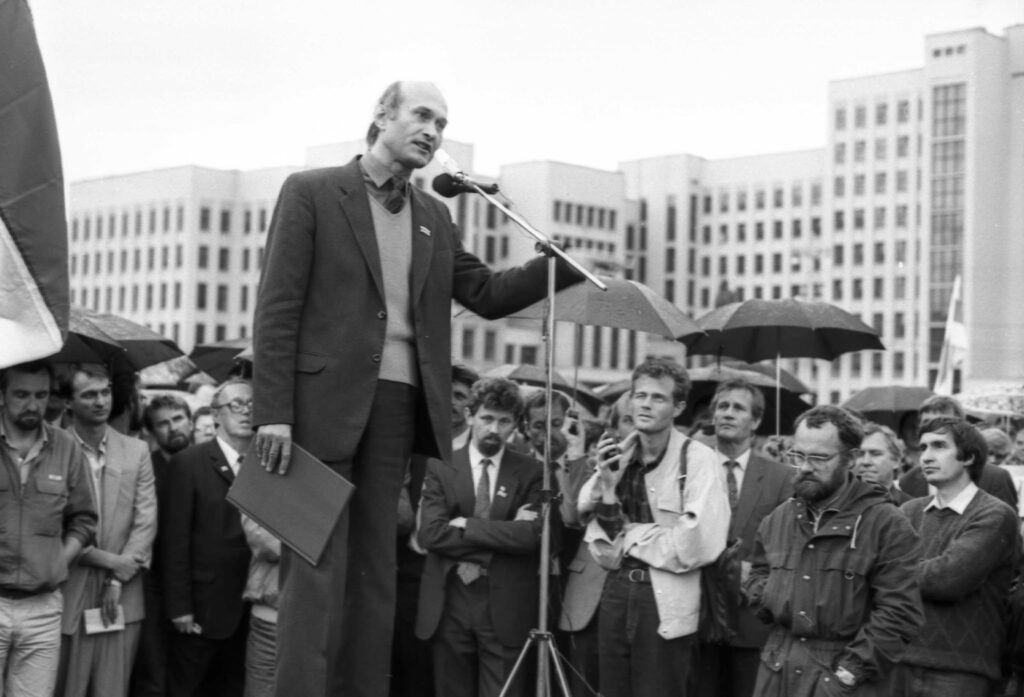
On the very first day of the coup, August 19, deputies of the Belarusian Popular Front (BPF) called people to a rally in the center of Minsk. BPF leader Zianon Pazniak condemned the GKChP as an illegal seizure of power and an attempt to restore a repressive Soviet regime. He led a column of protesters to the building of the Supreme Soviet.
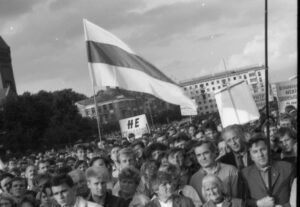
Their heroic resistance helped force the Belarusian authorities to make a choice. Under growing public and political pressure, the Supreme Soviet convened an emergency session.
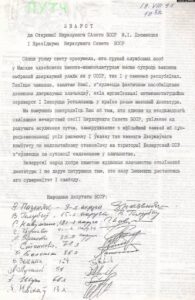
Parliament declared that the laws and Constitution of the Belarusian SSR took precedence over the orders of the coup plotters.
Resistance also came from within the military. Young officer Mikalai Statkevich refused to recognize the authority of the GKChP. During the coup, he announced the creation of the non-partisan Belarusian Association of Military Personnel (Belaruskae zhurtavannie vaiskoutsau, BZV) and, speaking on the radio, called on soldiers and officers of the Belarusian Military District not to obey the coup plotters’ orders.
“I fully understood what I was getting myself into, especially since I had two young daughters growing up. But alongside the fear for my loved ones, there was also a sense of happiness: I had done everything I could,” Statkevich later recalled.
The collapse of the coup dramatically accelerated the struggle for Belarusian independence. On August 25, 1991, the Supreme Soviet gave constitutional status to the Declaration of State Sovereignty, which had originally been adopted on July 27, 1990. This transformed the declaration from a political statement into the legal foundation of an independent Belarus.
The coup lasted only three days. But its failure became one of those turning points after which history could no longer return to its previous course. For Belarus, August 1991 marked a crucial step on the road to independence.
About The Author